Search This Blog

Showing posts with label earthquake. Show all posts

June 3, 2012

The Small Earthquake that can bring Italy down


Two relatively small earthquakes have hit Italy in May, the first one hit on the 20th of May with a magnitude of 5.9 and caused 7 dead and thousands of citizens abandoning their homes, then on the 29th of May another earthquake struck in the same area with a magnitude of 5.8 adding another 17 dead to the toll and a further 8000 fleeing their home, this time most of the victims were workers caught by the earthquake while at work in factories and warehouses that were destroyed or badly damaged by the cumulative effect of the second strike.

It is estimated that more than 3000 enterprises and factories have been damaged by those two earthquakes, after the first earthquake on the 20th of May all factories were checked for damages and were granted green light to resume production, unfortunately workers died under the rubble of crumbling warehouses when the second earthquake hit at 9 am on the 29th.

This time of course production in the factories has been stopped undefinetely until all structures are thoroughly checked for damages which could take months.

If we check a seismic map of Italy this area was considered as a safe one not requiring special precautions when building since no earthquake had been registered in the last 400 years.

Historically there was an extremely long series of earthquakes that struck the region in the 16th century and that went on for many years with hundreds of medium-low intensity earthquakes but not further activity since then.

It is true that most probably even if the area was highlighted as prone to earthquakes little would have changed in building practices, even critical areas prone to major earthquakes in Italy are still building with no seismic fail safe; corruption, carelessness and lack of rules are all ingredients to buildings being raised cheap and fast; ready to fall and boost the reconstruction business when disaster strike.

After all Italians still remember the laughs of joy of corrupt builders when informed of the earthquake of Aquila in 2009, transcripts of their phone calls were intercepted by Police in relation to bribery charges to former Berlusconi government officials.

Reconstruction is a major business for Italian builders; it boosts revenue and margins and incentivates them to build as bad as possible in order to increase the base of possible candidates, furthermore since even in case of proved negligence not even a builder has ever gone to prison, there is not even fear of retribution. This morally repulsive and economically destructive (for the society not for the builders) attitude has been dominant for many decades and it can explain why the most recent buildings are the first to collapse during an earthquake even before centuries-old historical buildings.

News of the first strike briefly appaered on major international news while the second one was mostly unreported although it has the potential of accelerating the Italian economic crisis to new heights and consequently affect the entire eurozone economy.

Let us be clear if terrorists would decide to cripple the economy of Italy they would have chosen the same area; destroy or paralyze the industrial production of The Emilia Region is equivalent to destroying 1-2 % of the Italian GDP with a consequent spiralling of the crisis.

This area alone is the backbone of Italy's industrial system, firms producing almost everything from biomedical to mechanics to food processing, current damages are 2 billion euros but aside from this a prolonged production shutdown will cause immense stress to the Italian tax revenue with a consistent shortfall and an almost sure missing of the budget parameters requested by the European fiscal compact.

If earthquakes will go on for months or even years as geologists are predicting, those factories that were already deeply affected by the global economic crisis will be out of business causing a major blow to an already crumbling Italian economy.

Pity that a similar earthquake in places such as Japan or California would have been just a small inconvenience with little or no damages.


September 20, 2011

Radiation could cause some Tokyo areas to be evacuated

The hidden Fukushima disaster is still an escalating issue and it appears that radiation in some parts of Tokyo is now higher than in the Chernobyl exclusion zone. Yesterday, Al Jazeera pointed out:
Experts estimate the radiation leaked from Fukushima nuclear plant will exceed that of Chernobyl.
The need to evacuate parts of the sprawling capital of 35 million may have once seemed an incredible prospect but some experts say the possibility can no longer be ignored
Japan Times reports today, the Japanese government started discussing the potential need to evacuate Japan soon after the quake hit:
In the days immediately after the crisis began at the Fukushima No. 1 nuclear power plant, the government received a report saying 30 million residents in the Tokyo metropolitan area would have to be evacuated in a worst-case scenario, former Prime Minister Naoto Kan revealed in a recent interview.

“It was a crucial moment when I wasn’t sure whether Japan could continue to function as a state,” he said.

After the March 11 earthquake and tsunami crippled the plant, Kan instructed several entities to simulate a worst-case scenario. One of those assessments said everyone residing within 200 to 250 km of the plant — an zone that would encompass half to all of Tokyo and cut clear across Honshu to the Sea of Japan — would have to be evacuated.


.

July 10, 2011

Just in: New Earthquake strike Japan, Tsunami alert launched

A 7.1-magnitude earthquake struck off the east coast of northern Japan Sunday, prompting tsunami advisories for several coastal regions, the Japan Meteorological Agency (JMA) said.
The U.S. Geological Survey said the earthquake struck at 10:57 a.m., about 143 miles east of Sendai, Japan.
Tsunami advisories were issued for the coastal regions of Iwate, Miyagi and Fukushima, the JMA said.
The areas were among the hardest hit by this year's devastating earthquake and tsunami.

June 4, 2011

Fukushima new radioactive alert at reactor 1

The latest news from Japan are clearly confirming that this crisis regardless of the cover up of the media, TEPCO and Japanese government is very far from over.

From  The Japan Times:


Tepco said today (Saturday the 4th) it has detected radiation of up to 4,000 millisieverts per hour at the building housing the No. 1 reactor at the Fukushima No. 1 nuclear plant.
The radiation reading, which was taken when Tokyo Electric Power Co. sent a robot into the No. 1 reactor building on Friday, is believed to be the largest detected in the air at the plant so far.

On Friday, Tepco found that steam was spewing from the reactor floor. Nationally televised news Saturday showed blurry video of steady smoke curling up from an opening in the floor.
Tepco has said radioactive water could start overflowing from temporary storage areas on June 20, or possibly sooner if there is heavy rainfall.
Two of the 370 tanks were due to arrive Saturday from a manufacturer in nearby Tochigi Prefecture, Tepco said. Two hundred of them can store 100 tons, and 170 can store 120 tons.
The tanks will continue arriving through August and will store a total of 40,000 tons of radioactive water, according to Tepco.
Nuclear fuel rods are believed to have melted almost completely and sunk to the bottom of three reactors' containers, although falling short of a complete meltdown, in which case the fuel would have melted entirely through the container bottoms.
Tepco has promised to bring the plant under control by January, but doubts are growing whether this projection is overly optimistic. The plan calls for a reprocessing system for the radioactive water by June 15, with hopes of reusing the water as coolant in the reactors.

March 25, 2011

Global nuclear risk map

The recent Fukushima Daiichi crisis has reopened the nuclear debate. Risk analysis and mapping firm Maplecroft has produced a global map of nuclear power stations, revealing the vulnerability to seismic, tsunami and storm surge risk of these facilities and the levels of energy security risks that countries face in the long-term.
The highest concentrations of seismic risk are concentrated around the ‘Pacific Ring of Fire’. Japan clearly stands out as having the highest concentration of nuclear facilities in an active seismic area, however Taiwan, South Korea and mainland China also have nuclear plants in areas exposed to either seismic or tsunami and storm surge hazards.
Further risks exist in the potential destructive power of storm surges. The eastern seaboard of the United States and northern coastal Europe are exposed to storm surges from intense low pressure weather systems (either tropical cyclones or severe extra-tropical cyclones). There are nuclear power facilities located in each of these regions and construction of these facilities will need to account for the storm surge potential.


March 17, 2011

The Perfect Storm

After the latest news from Japan it is quite clear we are entering uncharted territory, the situation at Fukushima is deteriorating by the minute, US government confirmed of lethal radiation spreading and even the Japanese government is openly speaking of nuclear disaster, if and when it will strike Tokyo is going to be a cataclysmic event. Already now the tab for this catastrophe is running on the trillions of US dollars ensuring that regardless of any future escalation Japan will have no choice than repatriating its investments abroad to sustain the internal need for reconstruction or containment.

When that will happen the crisis will be no longer a Japanese issue but a global one, both US and Europe markets will run dry of capital and the lack of buyers in the international sovereign market will wreck havoc on an already frail global economy.

This event together with the unrest in Libya and Bahrain is conjuring a perfect storm which is ready to conflagrate on our heads.

The reality is that too many events are accumulating and merging at the same time for anyone to be able to predict any short term forecast but it is certain at this point we are going for one hell of a ride.

The greatest risks we are facing at this moment and the latest development on the issue:

Nuclear crisis in Japan

Worst cases scenarios:
1) a 5000 degF mass of molten reactor materials could melt it's way through a damaged concrete floor, into a pocket of water or sea water below the plant, or rolling right into the ocean. Purely conjecture, but these are the mostly likely worst case scenarios.
2) Chernobyl type scenario, direct fire on the nuclear materials or, even worse, on the "used" nuclear waste that was being stored at reactors 4, 5, AND 6. Prior to last night, we never even heard of 5 or 6, now we find that rather than store the waste materials underneath a big mountain like in western United States, that they decided last fall to store all the old materials in the facilities next to the working nuclear plants, on the ocean, on the ring of fire.

The chairman of the United States Nuclear Regulatory Commission gave a significantly bleaker appraisal of threat posed by the Japanese nuclear crisis than the Japanese government, saying on Wednesday that the damage at one crippled reactor was much more serious than Japanese officials had acknowledged and advising to Americans to evacuate a wider area around the plant than ordered by the Japanese government.

A derivative-fueled banking crisis

It is still not clear how the derivative market could be affected by the recent interruption of the currency carry trade caused by the sudden spike of the Japanese Yen toward the dollar.
A previous disruption of the currency carry trade in 2008 was one of the main factors in triggering the economical crisis, by comparison the potential for disruption of the derivatives market is many times more serious this time, there is not enough data yet to follow the events on this side but it something I will keep monitoring closely in the following weeks.

Critical shortages

Libya's civil war has cut global crude supply by 1.1m barrels per day (bpd).
Now events in the Gulf have turned dangerous after Saudi Arabia sent troops into Bahrain to help the Sunni monarchy crush largely Shi'ite dissent, risking a showdown with Iran.
Russia's finance minister Alexei Kudrin warned on Wednesday that the confluence of events in Japan and the Mid-East could push oil to $200 a barrel in a "short-lived" spike, which would snuff out global recovery.
The shutdown of 11 reactors in Japan has cut 10 gigawatts (GW) of power, forcing the country to import other fuels to keep its economy going. "We think they will need an extra 200,000 bpd of fuel oil and light crude, as well liquefied natural gas," said Eduardo Lopez from the International Energy Agency.
The closure of seven German pre-1980 reactors will cut energy supply by a further 6.2 GW, according to Daniel Brebner at Deutsche Bank.
US Energy Secretary Steven Chu also asked Congress for $36bn in loan guarantees for a new generation of small modular reactors. He has the backing of Capitol Hill for now but support could evaporate if Japan's containment vessels rupture. The world has 442 reactors, with 65 under construction. They generate 372 GW, covering 13.8pc of global electricity. The share is higher in the rich world: France 75pc, Belgium 52pc, Ukraine 47pc, Korea 35pc, Japan 29pc, the US 20pc, and the UK 18pc. In China it is just 2pc.

Global GDP collapse

A 1989 interesting and forgotten until now report on the consequences of a major earthquake in Tokyo and it far reaching consequences on the global economy can be found HERE
In brief 2/3 of Japanese production is concentrated in the Tokyo area and 1/3 of everything that is sold in Japan is sold in the Tokyo area, it is not difficult to imagine that any radiation contamination in the Tokyo area would cripple the country and by consequence the world economy, furthermore Japan will start retrieving investments from abroad spreading contagion on the world markets.

How an economical tsunami would unfold is described in Michael Lewis report:

Shock 1: earthquake strike Tokyo
Shock 2: foreign exchanges fall as insurance companies start dumping stocks and bonds to cover Japanese claims
Shock 3: Japan start to liquidate its overseas holdings to finance reconstruction at home
Shock 4: Withdrawal of Japanese money causes the bond market to collapse and interest rates to soar.
Shock 5: High rates raises prices while depressing real estate development, savings and loans and GNP.
Shock 6: The world will face year of declining growth and instability

Of course even in his apocalyptic view the author would have never imagined a nuclear crisis on the top and the risk of evacuation of one of the biggest cities in the world, in this case consequences could be much more severe and lasting than those described into the report.

Sovereign crisis in Europe and US

Europe will face the same problem than US in financing its debt, it will struggle to find alternative buyers and a major fire sales of debt by Japan could trigger an escalation of the sovereign crisis.
Needless to add that any interest rate increase will strike the final blow to the battered mortgages and construction bubbles in Spain, Ireland and the USA while precipitating other countries as Italy in the same downward spiral.

Conflict in North Africa/Middle East

The UN has agreed on a draft resolution to implement a no fly zone over Libya, which means the bombing may commence as soon as the vote passes later today. As to what Gaddafi's retaliation will be, and whether he will burn down the oil wells, which previously were in rebel hands, but have since fallen back into his control, we will surely find out in the next 24 hours.
As for Bahrain, the capital, Manama, was under curfew from 4pm to 4am, and the government was using emergency laws to ban public gatherings. The central square known as Pearl Roundabout, which had been a base for the protest movement, was violently cleared by riot police.
The US secretary of state, Hillary Clinton, led diplomatic reaction to the violence, delivering a stern warning to Bahrain's rulers. Clinton said Bahrain, and neighbouring Gulf states that have sent troops to help quell the uprising, were "on the wrong track". She demanded that Bahrain show restraint with demonstrators and keep hospitals open.
She described the situation in Manama as alarming and condemned the use of force against demonstrators.
Saudi Arabia has a restive Shia minority near its border with Bahrain, which accounts for roughly 12% of its population. Saudi's rulers have long viewed the Shia as a potential threat. Commentators say Riyadh was not prepared to tolerate demonstrations that would weaken it by proxy and empower its arch foe, Iran.


March 15, 2011

Japan aftershocks expected to reach magnitude 7-8

For Japan, it's nowhere near over, at least if the Pasadena Jet Propulsion Laboratory is correct. While Japan has experienced numerous magnitude 5 and 6 aftershocks (405 in total to be precise), the big ones are still to come: "Japan's largest quake on record, which hurled a 7-meter (23-foot) wave landward after one plate slid beneath another off the coast of Sendai, had an 8.9 magnitude.The aftershocks will likely include at least one measuring 8 and 10 of magnitude 7, JPL geophysicist Andrea Donnellan said. All are many times larger than the 6.3-level New Zealand quake in February that leveled the Christchurch business district and killed 160."

March 13, 2011

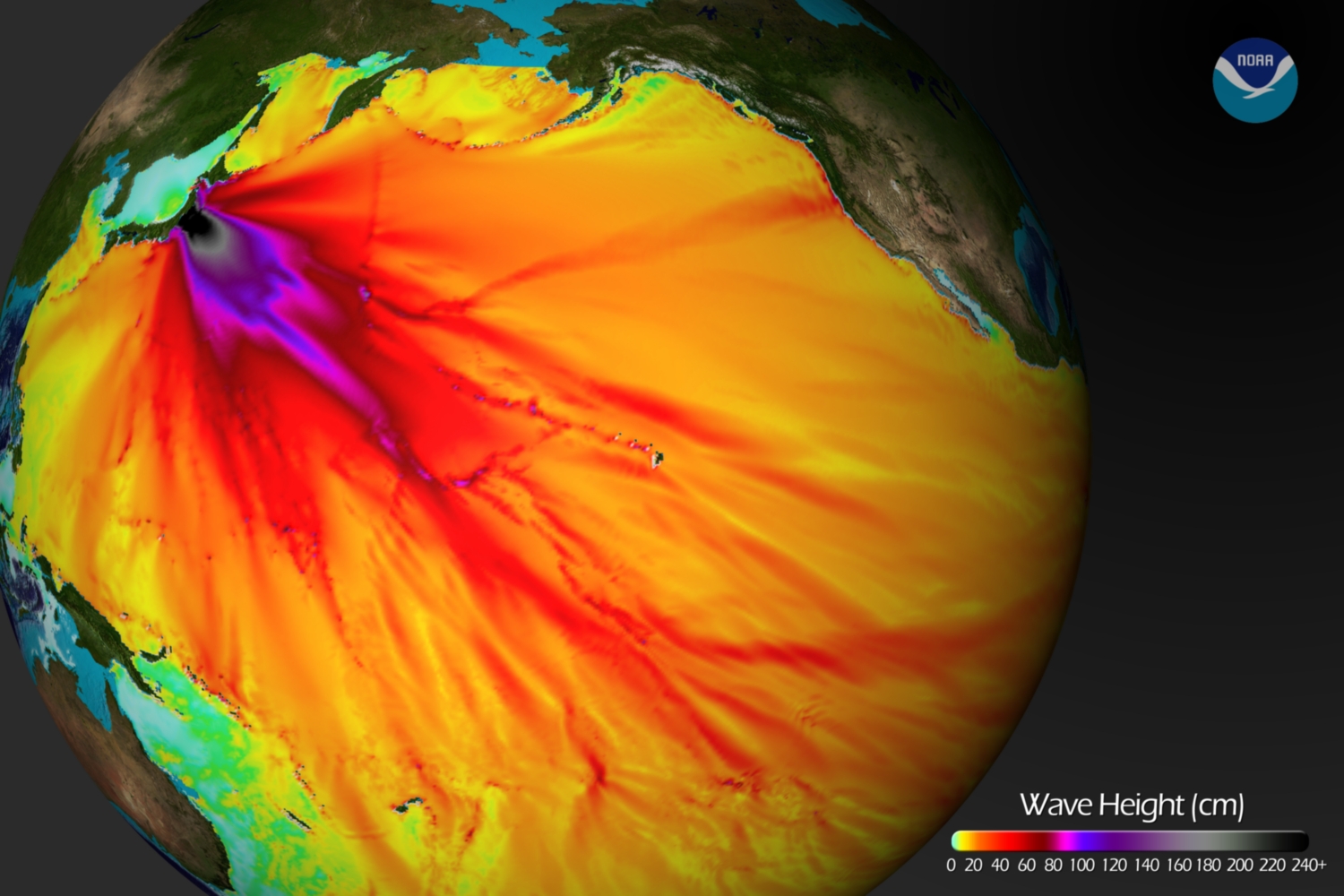
Japan's Tsunami visualized


Another great illustration frome NYT reviewing how the shifting tectonic plates in the earth’s crust caused the earthquake and tsunami in Japan.

>

Source: NOAA Center for Tsunami Research, Pacific Marine Environmental Laboratory
>

UPDATE:
This is a slightly different angle showing the same thing, via NOAA
click for larger image

http://www.nnvl.noaa.gov/MediaDetail.php?MediaID=680&MediaTypeID=1