Search This Blog

Showing posts with label peak oil. Show all posts

August 26, 2012

Isaac threaten "monster" oil price jump


Brent crude jumped to $115 a barrel last week and petrol costs across much of Europe are now at record levels.
Diesel is above the political pain threshold of $4 a gallon in the US, hence reports circulating last week that the International Energy Agency (IEA) is preparing to release strategic reserves.
Barclays Capital expects a “monster” effect this quarter as the crude market tightens by 2.4m barrels a day (bpd), with little extra supply in sight.
Goldman Sachs said the industry is chronically incapable of meeting global needs. “It is only a matter of time before inventories and OPEC spare capacity become effectively exhausted, requiring higher oil prices to restrain demand,” said its oil guru David Greely.
This is a remarkable state of affairs given the world economy is close to a double-dip slump right now, the latest relapse in our contained global depression.
A further risk to oil production has materialized with Tropical Storm Isaac which now looks set to threaten New Orleans and the Gulf. Weather trackers are predicting an increase in intensity given its size and the storm's predicted paths are set to cross straight through the middle of the Gulf's oil production in a replay of the terrible August of Katrina. All major rig operators are evacuating which leaves output notably down already.
24% of oil and 8,2% of natural gas output has been shut down for tropical storm Isaac and markets will be monitoring the situation closely tomorrow.
During Katrina prices rose by 75c and given tight reserves at this moment the situation could get even worst.
Isaac's predicted path (via NOAA)

[Image of 5-day forecast and coastal areas under a warning or a watch]


goes straight through the oilfields... (source: Forbes)


March 4, 2012

Peak Oil Pain is back!

For anyone interested to understand what is the effect of peak oil on economy I would recommend reading this excellent article on The Telegraph, brief excerpts below:

[Energy costs at 9pc of global GDP] That proved to be the pain barrier in the 1970s and again in 2008, and we are just shy of that level right now. “Oil is already capturing a higher level of European GDP than in 2008,” said Francisco Blanch from Bank of America.

The unpleasant fact we must all face is that the relentless supply crunch - call it `Peak Oil’ if you want, or `Plateau Oil’ - was briefly disguised during the Great Recession and is already back with a vengeance before the West has fully recovered.
The IEA said non-OPEC production stalled in 2010 and 2011. There was no net increase. While there was a boost from Canada’s tar sands, and America’s shale-oil, and Brazil’s offshore rigs, this was offset by the relentless erosion of the North Sea fields and Mexico’s operations, a collapse in the Sudan, and Libya’s woes.
Meanwhile OPEC spare capacity has fallen to 2.5m barrels a day (bpd), compared to 3.7m this time last year during the Arab Spring, the event that caused a comparable spike in crude prices and arguably triggered the sharp global slowdown a few months later.

The issue is not whether Iran has the military kit to close the Straits of Hormuz and cut off 18pc of global oil shipments for more than a few days (probably not), but whether an Israeli/US attack on the regime’s nuclear facilities would later set off an uncontrollable chain of events in the Middle East.
There is clearly danger of a spill-over into Bahrain and the eastern province of Saudi Arabia, home to the Kingdom’s aggrieved Shia and most of its oil. Even so, the Iran risk premium in global crude prices is only $10 to $15. We must still face the overwhelming fact that global energy supply is on a knife-edge regardless of events in the Gulf - with no relief in sight.

The IEA warned in its annual report that energy demand will rise 40pc by 2035. 

China alone will be adding 125m cars to its roads over the next five years, with auto production targets of 30m annually by 2016. India is spending $1 trillion on infrastructure projects over the next five years.
Variants of this are happening across Asia and Latin America. Two billion people in the emerging world are joining the global economy and competing toe-to-toe for scare resources with the West.

January 2, 2012

Iran military plans for the Strait of Hormuz


Amid Iran's missile escalation announced on the mainstream media today we are wondering what would a closure of the Strait of Hormuz looks like. The Middle East Media Research Institute's blog has caught a release by an Iranian website Mashreq News, which spells out the step by step details of just how such a closure would be enacted.

From MEMRI:

In response to threats by Western countries to impose oil sanctions on Iran, the Iranian website Mashreq News, which is close to Iranian military circles, posted an article on December 15, 2011 outlining military measures that could be taken by Tehran to close the Strait of Hormuz should the regime choose to do so.
The article enumerated the forces and weapons that Iran could employ in such a military operation, including fast attack craft carrying anti-ship missiles; submarines; battleships; cruise and ballistic missiles; bombers carrying laser-, radar- and optically-guided missiles; helicopters; armed drones; hovercraft; and artillery.
It stated that despite Iranian Supreme Leader Ali Khamenei's statements that Tehran would not initiate a military confrontation but would retaliate harshly if attacked, "there is no guarantee that [Tehran] will not launch a preemptory strike on the civilian level, for instance through cyber-warfare or by means of economic pressure, including by closing the Strait of Hormuz and cutting off [this] energy lifeline for an indefinite period of time." It added, "Should additional sanctions be imposed on Iran, especially in the domain of oil export, Iran might keep [its] oil from leaving its territorial waters."
In a further threat, the article stated that Iran would in the future be able to attack the 480-km pipeline with a capacity of 2.5 million barrels/day that the UAE is planning to build in order to bypass the Strait of Hormuz in order to neutralize Iran's ability to disrupt the world's oil supply: "As for the plan... to construct a [pipeline] from the UAE that will be an alternative in times of emergency in case the Hormuz Strait is closed, we should note... that the entire territory of the UAE is within range of Iran's missiles, [so Iran] will easily be able to undermine security at the opening of this [pipeline] using weapons to be discussed this report."
In accordance with Iranian doctrine, the article pointed out that these weapons would actually not be necessary because there would be suicide operations, and added that "the faith of the Iranian youth, and their eagerness to sacrifice their lives, will sap the enemies' courage."
Despite statements by Iranian government spokesmen, including Oil Minister Rostam Qasemi and Foreign Ministry spokesman Ramin Mehmanparast, that the closing of the strait is not currently on Iran's agenda, Majlis National Security Committee member Pervez Sarouri said that the Iran would be conducting 10 days of naval maneuvers, called "Velayat 90," beginning December 24, 2011, to drill closing it.

Satellite view of the Strait of Hormuz connecting the Persian Gulf to the Sea of Oman

The following are the main points of the Mashreq News article on closing the Strait of Hormuz.

Fast Attack Craft
The article stated that since it first introduced fast attack craft for use in the Iran-Iraq war (1980-1988), the Iranian navy has immeasurably improved the craft's "ability to face advanced enemy combat vessels, much less cargo ships. These boats are equipped with sea radar systems; advanced electronic communication systems; sea-to-sea cruise missiles, both short-range – 25 km – and medium range; medium- and large-caliber [sic] torpedoes; and naval mines, along with traditional means of warfare – including semi-heavy machine guns, missile launchers, and shoulder-launched anti-aircraft missiles. These sea craft are capable of blocking the Strait [of Hormuz] for a brief or an extended period, and of facing enemy warships trying to open the route.

"In addition to their high speed and abovementioned equipment, these sea craft are highly maneuverable. Their ability to operate at night, aided by the requisite accessories, as well as in stormy weather, has been demonstrated repeatedly in recent years, in maneuvers both minor and major. Their successful record includes stopping submarines from countries beyond the [Gulf] region that aimed to cross the Strait of Hormuz, and supporting [Iranian] submarines threatened by enemy warships in the Indian Ocean... Iran has various types of naval mines, both stationary and remote controlled. This weapon [i.e. the mines] may, if necessary, be operated by Iranian boats and submarines [located at] various points in the Strait of Hormuz and the surrounding waters."
Submarines
The article continued: "The Iranian navy's acquisition of submarines... some 20 in number... has rendered it more powerful than the navies of the [other] countries in the region. Iran's submarine craft can use torpedoes, mines, and missiles, and can remain submerged for weeks in order to accomplish a mission. Apart from the Russian Kilo class submarines, the Nahang, Ghadir, and Fateh class submarines have been pre-fitted for the waters around Iran, especially the Persian Gulf... These submarines can remain stationary in the water and can evade various enemy radar and sonar systems...
"The Kilo class submarines can carry 24 mines or 18 large torpedoes, while the Fateh class submarines can carry 12 torpedoes and/or eight mines. In addition, there have been reports in the international media stating that Iran has equipped the Kilo class [submarines in its fleet] with Hoot torpedoes...
"The Ghadir class submarines can also successfully participate in the operation [to close the strait]... [These] are small submarines manned by one or several people. Known as 'wet submarines,' they are used for commando operations, laying mines, and firing torpedoes... and can operate in narrow and shallow areas."
Warships
The article stated that "Iran has various classes of missile ships, warships, and destroyers. These marine craft are capable of launching four 'Nour' anti-ship missiles, which have a range of 120-170 km, [even] over 200 km. Additionally, these warships' 114mm and 76mm guns... can threaten various [types of] ships. [Iran's] warships can [also] threaten submarines while simultaneously operating together with the rest of the [Iranian naval] force in closing the Strait of Hormuz."

Anti-Ship Cruise Missiles
It continued: "We divide Iran's missile force into two groups: cruise missiles and ballistic missiles. They possess a wide variety of ranges and destructive capabilities. Coastal launchers for Kowsar short-range missiles and for Nour and Ghadir missiles [with a range of some 200 km] have so far been displayed, and the Naser-1 medium-range missiles are launched from Qare'a triple-barrel missile launchers. These launchers are independent, meaning that if they are deployed near the coast, they could detect and identify naval targets and attack them without the need for supporting systems from [Iranian] air and naval units.

"These systems can cover most of the Strait of Hormuz if deployed and camouflaged 70 to 150 km deep into Iranian territory, or even in the Kerman province [in southeastern Iran]. The Iranian armed forces possess these systems in abundance, and they are ready for deployment."
Ballistic Missiles
The article noted: "...Thus far, three types of anti-ship ballistic missiles have been displayed in Iran: Khaleej-e Fars, Tondar, and Sejil. Khaleej-e Fars missiles, with a 300-km range and a 650-kg warhead, are designed to destroy enemy warships. The missile can be prepared for launch in a few minutes due to its use of solid fuel and advanced guidance systems. It strikes the enemy ships from above, traveling at Mach 3, reaching [the target] in a short time and at an acute angle.

"The triple-barrel launcher for these missiles provides sufficient firepower from the first launch; it increases the operational effect of the missile, while decreasing the enemy's ability to retaliate. Based on photos of the missile, it uses an electronic guidance system, which ensures its effectiveness even against the enemy's electronic warfare. The missile's speed, angle of approach, and impact from above are effective points in its modus operandi. We can estimate that the enemy's chances of intercepting it are miniscule.
"The Tondar missile, whose range is estimated by experts to be 150-250 kilometers, operates alongside the Khaleej-e Fars missiles as a short range ballistic missile... and their combined operation can significantly raise the chances of hitting the target... The [Tondar] missile can cover the Straits of Hormuz from deep inside Iranian territory. The Khaleej-e Fars missile can cover the Western Sistan-Baluchestan area, the Kerman province area, eastern and southern Fars province, and all of the Straits of Hormuz."

"The most terrifying of all Iranian missiles is the Sejil long range missile. It has commonly been considered merely a surface-to-surface missile, but the armed forces recently announced that it can also be used to destroy naval targets. Although not much is known about the missile's guidance and targeting systems, the missile has shown great accuracy in hitting a predetermined target. This missile, with a range of 2,000 km, can reach speeds of Mach 8 to Mach 12 (2,700-4,100 meters per second)... Its warhead weighs at least 500 kilograms, helping it to destroy the target. This missile can be used to cover regions beyond the Strait of Hormuz even if deployed on the northern Iranian coast, or at the most distant point in northwest Iran. It is a two-stage rocket powered by solid fuel, and reaches great speed at the end of the first stage [of launch]. It is difficult for the enemy to detect and track it during the first stage, because it uses several methods to reduce its radar signature... Thanks to its high velocity, the chance of it being hit by enemy defense [systems] is even smaller than the chance that they will hit a Khaleej-e Fars missile.
"Such missiles would be launched from deep inside Iranian territory because scattering launchers over a larger area will make it difficult for the enemy to detect them, will limit the means the enemy will be able to use to destroy them, and will also allow the launchers to be relocated and re-camouflaged.
"Although the enemy is much more likely to detect lower-velocity missiles... the combination of the use of these weapons in areas both closer and farther away from the shore and the increased number of targets... can maintain their effectiveness."
Bomber Jets
The article stated: "Iranian fighter jets can carry various types of air-to-surface missiles that can operate against naval targets, including air-to-surface missiles with optical, laser, and radar guidance; Nour and Ghadir missiles adapted for aerial use; C-801K and C-802 missiles; as well as Kowsar and Naser missiles. [Iranian] Air Force jets can carry up to five such missiles.

"Additional missiles for naval targets include: limited range TV-guided Maverick missiles; Qassad-1 and Qassad-2 optically guided bombs with a range of 30-50 kilometers (Qassad-3 bombs, with a range over 100 kilometers, will become operational soon); and Russian-made KH-25 and KH-29 missiles with laser and optical guidance, which can be mounted on Su-24, Su-25, and MiG-29 jets. Their range is 10km-30km, and they have medium destructive capabilities.
"In addition, KH-58 long-range anti-radar missiles, which can be mounted on Su-24 jets for attacks on enemy warships, will play an important role in closing the Strait of Hormuz.
"The array of missiles and bombs with varying ranges will assist Iran in operating remotely against enemy frigates and warships."
Helicopters
"The Shahed 285 helicopter can carry Kowsar anti-ship cruise missiles, and Mi-171 helicopters can launch Nour long range missiles, and apparently Ghadir missiles as well. These helicopters, along with Cobra attack helicopters, can threaten merchant vessels and enemy warships."

Flying Boats
"Only one model of flying boat has thus far become operational in Iran. In fact, it is a new type of plane that can land on the water, and can be equipped with anti-ship missiles. This boat can take off from the water, from various points on Iran's coast, and can operate against enemy warships together with aerial defense."

Drones
"The Iranian army drones are used for anti-ship missions. The Karar drone can carry four Kowsar missiles. Due to its speed, the drone can increase the potential energy of the missiles and extend their range. The drone has a range of some 1,000 km; it is launched by a rocket, and when it reaches the correct range, it launches the missiles. Karar drones can carry dozens of missiles to the enemy warships.
"The Karar drone is made from materials that allow it to evade radar detection and get close to enemy vessels. Nevertheless, the drone can also use missiles like Naser-1, for large areas."

Artillery and Surface-to-Sea Rocket Systems
The article also claimed that Iranian security officials several times pointed out that guided bombs are actually being used against moving naval targets. It said that the range of Iranian artillery shells is over 40 km, and that they can be used to harm or destroy enemy ships. It added that during maneuvers, Iran had successfully utilized the Fajr-3 and Fajr-5 rocket launchers against naval targets.

July 22, 2011

Cyprus energy disaster: what to expect when energy crunch hits

The international media has ignored a real energy crisis developing in the Mediterranean island of Cyprus, the story itself is quite surreal and symptomatic of how dire and fast the situation can develop when an energy crisis hit a country.
For the majority who never heard of this story which was decently covered only by BBC for few days let us do a recap:
On the 11th of July flames from a small fire on the Evangelos Florakis Naval Base near Zygi reached 98 containers of explosives that were being stored on the base.
The resulting explosion killed 13 people, 12 of them immediately, including Captain Andreas Ioannides, the Commander of the Navy (Cyprus's most senior naval officer), and the base commander, Lambros Lambrou. Also killed were four navy personnel and six fire-fighters, while a further 62 people were injured. The explosion severely damaged hundreds of nearby buildings including the island's largest power station, responsible for supplying over 60% of Cyprus' electricity.
As a result, much of Cyprus is without power and rolling blackouts have been initiated in order to conserve supplies.
The 98 containers of Iranian high explosives where seized in 2009 and since then were sitting calmly under the scorching sun of Cyprus at the naval base right next to the power plant.
No comment on the total stupidity of leaving explosives under the sun next to a strategic energy hub with temperatures that reach 45 Celsius in summer.
The more interesting part though is the current situation with an entire country lacking electricity with rolling blackouts running wild and with remaining old power plants struggling to cope, just today the other remaining power plant suffered a failure and technicians are scrambling to avoid a disaster.
It could take up to 1 year, to rebuild the destroyed power plant supposed the government is able to find 1 billion Euro they do not have at this moment, and it will be interesting to see what damage a prolonged energy crisis can do to a country.
Cyprus is in a dire economical situation with industry and services paralysed by the lack of electricity, there are no scheduled black-outs so there is no telling when lights will be off and no planned working activity is possible, motorists are facing the greatest risk at crosslights and emergency services are in complete chaos.

Cyprus economy is in a state of emergency comparable to 1974 and is facing an imminent EU bailout. 
Cyprus Central Bank governor Athanasios Orphanides warned yesterday: "To avoid the worst, including admission into (a) support mechanism and all that that entails for the economy ... further and more drastic measures must be taken immediately,"
Cyprus was already under market pressure because of its links to debt-laden Greece, and following the tragic explosion economists have warned the island could face a bill of up to €1 billion just to reinstate electricity supplies.
"Weighing all the facts, the unfavourable international environment, the difficulties in resorting to external borrowing and the additional economic impact from the recent events, I believe the economy is in a state of emergency, comparable to that of 1974," Orphanides said, referring to the Turkish invasion and its aftermath.
Cyprus is unfortunately set to become the first reality laboratory for an energy crunch crisis, worth keeping an eye on this small Mediterranean island in the following months.

June 26, 2011

Peak Oil impact on the economy

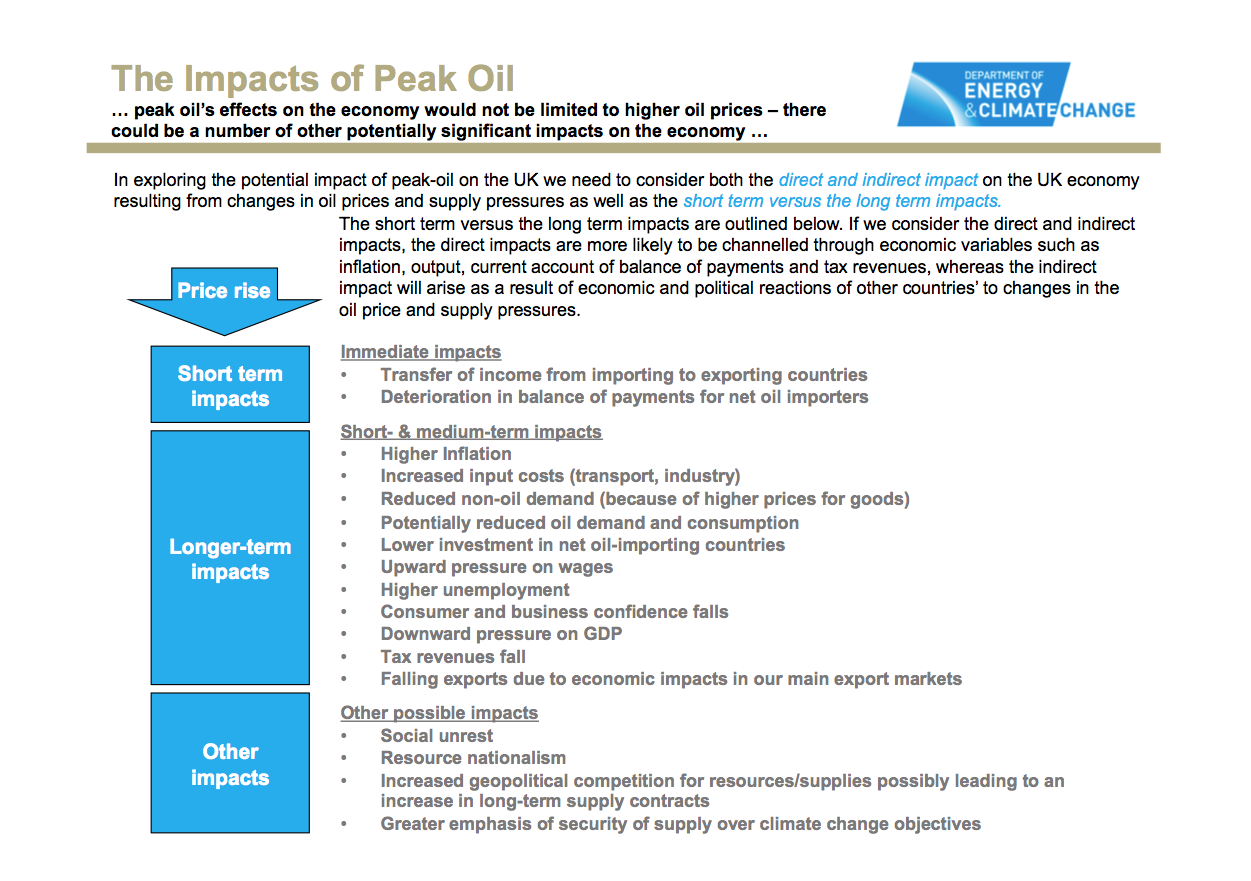
The Guardian has released an internal UK government report on peak oil.
UK government 2 years ago ignored warnings about Peak Oil and played them down as alarmist and irrelevant. The report was eventually released under a Freedom of Information Act (FOIA) request:

The best analysis of this report has been published by The Oil Drum:

Of the 17 bullet points on the slide, 16 have come to pass in the UK and in the neighbouring countries of Europe (click on slide to enlarge and open in separate window). Given that the research was conducted in 2007 and the report compiled in 2009, this conveys amazing insight.

Two important items are missing from the list and when these are taken on board, the story is complete.
1. Peak oil may threaten the global banking and financial system since the Ponzi scheme of growth based on credit expansion requires a growing stream of cheap energy to fuel the real economy. When the stream of cheap fuel dried up, the real economy failed, toppling the global fractional reserve banking system that lay at the heart of the Ponzi scheme. Fractional reserve banking has now been supplemented by Quantitative Easing as a means of creating money to drive consumption of finite reserves.
2. Peak oil will threaten pensions since these are based upon the excess net energy produced from high ERoEI energy sources (Energy Return on Energy Invested). As the ERoEI declines and the lifeblood of cheap net energy dries up, it is inevitable that society's ability to care for those not in work (young, old and dysfunctional) will be steadily eroded. This links to point 1 above via declining stock market valuations.
It seems that the global economy may be on the rocks again for the second time in three years, stemming from energy prices that society can ill afford to pay.

June 11, 2011

Peak Oil alert gaining momentum

Since 2006, the international oil company TOTAL has consistently voiced warnings about the future inability of the oil industry to meet continued oil demand growth. In 2006, then CEO Thierry Desmarest stated that maximum oil production lies between 100 to 110 million b/d, reached potentially by 2020. Only a year later the new CEO Christophe de Margerie announced that it would be difficult for the industry to produce beyond 100 million b/d.


To summarize, according to TOTAL the world can likely not produce over 95 million barrels per day due to constraints in producing more technically challenging oil fields such as deepwater, heavy oil, and fields located in the arctic. Furthermore, such a production level is only possible if the countries in the Middle-East, especially Saudi-Arabia, Iran, and Iraq, will be able and willing to increase their production.
Ad when it comes to Saudi Arabia being able to increase production well the latest news are not encouraging:

From elEconomista.es (translation in English here)

The electricity company of Saudi Arabia warns that oil in this country could be depleted by 2030 if left unchecked domestic consumption. According to a report of Saudi Electric, domestic consumption is estimated to be between 2.5 and 3.4 million barrels a day.

The report, published in the magazine Al Mashka says that the increase in domestic consumption of oil is one of the main challenges facing the country, mainly because oil accounts for 80% of national income.

Abdel Salam al-Yamani, head of the Saudi Electricity Company also warned of the consequences for citizens to ignore the calls to save electricity and water, and has advised that they depend more on solar energy.

It appears the Saudi governement is well aware of this issue since on the 1st of June announced its intention to build 16 nuclear power plants which is quite ironic for a country supposedly full of oil.

From Reuters

DUBAI, June 1 (Reuters) - Saudi Arabia plans to build 16 nuclear power reactors by 2030 which could costs more than $100 billion, a Saudi-based newspaper reported on Wednesday, citing a top official.

The world's top crude exporter, Saudi is struggling to keep up with rapidly rising power demand. It has considered boosting its domestic energy capacity using nuclear reactors.

"After 10 years we will have the first two reactors," Abdul Ghani bin Melaibari, coordinator of scientific collaboration at King Abdullah City for Atomic and Renewable Energy, told Arab News.

Many have backed away from atomic plans after the accident at Japan's Fukushima Daiichi plant but oil-rich Gulf states are among the few countries looking to make major investments in nuclear power plants.

"After that, every year we will establish two, until we have 16 of them by 2030," he said.

Also from The Economist: Oil production fails to keep up with demand

CRUDE-OIL prices shot up on June 8th—Brent crude to a one-month high of $118.59 per barrel—after OPEC representatives meeting in Vienna were unable to reach an agreement on production quotas. Many had expected an increase in quotas as members with spare production capacity, led by Saudi Arabia, pushed to avoid a price spike that may dampen long-term demand. As figures released in BP’s "Statistical Review of World Energy" show, global oil production has struggled to keep up with increased demand recently, particularly from Asia. In China alone consumption has risen by over 4m barrels per day in the past decade, accounting for two-fifths of the global rise. In 2010 consumption exceeded production by over 5m barrels per day for the first year ever, as world oil stocks were run down.

Long-term consumption cannot exceed production. Even in short time frames, consumption can only exceed production if there is sufficient production in storage.
To cover 5 million barrels per day of excess consumption for a year, global oil stocks would have had to drop by 1.825 billion barrels. If that did not happen, we need another explanation.

Possible Explanations

Cheating (under-reporting production) by OPEC
Poor consumption numbers from China or elsewhere
Another source of production not shown
Some combination of the above 

Regardless, it simply is not possible for oil consumption to grow faster than production for years on end.

June 8, 2011

46 years of proved oil reserves left

In its just released must read Statistical Review of World Energy, BP has many important observations.

From the report:

"World primary energy consumption – which this year includes for the first time a time series for commercial renewable energy – grew by 5.6% in 2010, the largest increase (in percentage terms) since 1973. Consumption in OECD countries grew by 3.5%, the strongest growth rate since 1984, although the level of OECD consumption remains roughly in line with that seen 10 years ago. Non-OECD consumption grew by 7.5% and was 63% above the 2000 level. Consumption growth accelerated in 2010 for all regions, and growth was above average in all regions. Chinese energy consumption grew by 11.2%, and China surpassed the US as the world’s largest energy consumer. Oil remains the world’s leading fuel, at 33.6% of global energy consumption, but oil continued to lose market share for the 11th consecutive year." And in terms of production reserves: "World proved oil reserves in 2010 were sufficient to meet 46.2 years of global production, down slightly from the 2009 R/P ratio because of a large increase in world production; global proved reserves rose slightly last year. An increase in Venezuelan official reserve estimates drove Latin America’s R/P ratio to 93.9 years – the world’s largest, surpassing the Middle East."

There is much more in the full report, but three charts bear a simple conclusion, crude prices likely have a long way to go up unless the global economy promptly commences another 2008 mega deflationary episode (read economic crisis).

Reserves-to-production (R/P) ratios:

And Real crude Prices since the Pennsylvania Oil Boom:


World trade movements of crude:


And the full booklet:
2030 Energy Outlook Booklet

April 11, 2011

Russia rush ahead of Saudi Arabia as top oil producer

The conclusion we can get from this historical data is that either Saudi Arabia is cutting production or they have reached peak level and in that case it would be a confirmation that we have passed peak oil globally.


chart
Top 30 oil producing countries (those increasing production over 2009 are shown in red).

March 5, 2011

The collapse of the old oil order

DLR studies: hypothetical infrastructure of HV...Image via Wikipedia
Very insightful and finally honest article on how our oil turmoil will affect our lives in the coming years another excellent and detailed article from Le Monde Diplomatique:

Whatever the outcome of the protests, uprisings, and rebellions now sweeping the Middle East, one thing is guaranteed: the world of oil will be permanently transformed. Consider everything that’s now happening as just the first tremor of an oilquake that will shake our world to its core.
For a century stretching back to the discovery of oil in southwestern Persia before World War I, Western powers have repeatedly intervened in the Middle East to ensure the survival of authoritarian governments devoted to producing petroleum. Without such interventions, the expansion of Western economies after World War II and the current affluence of industrialized societies would be inconceivable.
Here, however, is the news that should be on the front pages of newspapers everywhere: That old oil order is dying, and with its demise we will see the end of cheap and readily accessible petroleum — forever.
Let’s try to take the measure of what exactly is at risk in the current tumult.
In 2009, the most recent year for which such data is available, BP reported that suppliers in the Middle East and North Africa jointly produced 29 million barrels per day, or 36% of the world’s total oil supply — and even this doesn’t begin to suggest the region’s importance to the petroleum economy.
As it happens, Middle Eastern producers will be even more important in the years to come because they possess an estimated two-thirds of remaining untapped petroleum reserves. According to recent projections by the U.S. Department of Energy, the Middle East and North Africa will jointly provide approximately 43% of the world’s crude petroleum supply by 2035 (up from 37% in 2007), and will produce an even greater share of the world’s exportable oil.
So far, the most important Middle Eastern producer of all, Saudi Arabia, has not exhibited obvious signs of vulnerability, or prices would have soared even higher. However, the royal house of neighboring Bahrain is already in deep trouble.
Even if rebellion doesn’t reach Saudi Arabia, the old Middle Eastern oil order cannot be reconstructed. The result is sure to be a long-term decline in the future availability of exportable petroleum.
Three-quarters of the 1.7 million barrels of oil Libya produces daily were quickly taken off the market as turmoil spread in that country. Much of it may remain off-line and out of the market for the indefinite future.
The critical player is Saudi Arabia, which just increased production to compensate for Libyan losses on the global market. But don’t expect this pattern to hold forever. Assuming the royal family survives the current round of upheavals, it will undoubtedly have to divert more of its daily oil output to satisfy rising domestic consumption levels and fuel local petrochemical industries that could provide a fast-growing, restive population with better-paying jobs.
In April 2010, the chief executive officer of state-owned Saudi Aramco, Khalid al-Falih, predicted that domestic consumption could reach a staggering 8.3 million barrels per day by 2028, leaving only a few million barrels for export and ensuring that, if the world can’t switch to other energy sources, there will be petroleum starvation.
In other words, if one traces a reasonable trajectory from current developments in the Middle East, the handwriting is already on the wall. Since no other area is capable of replacing the Middle East as the world’s premier oil exporter, the oil economy will shrivel — and with it, the global economy as a whole.
Consider the recent rise in the price of oil just a faint and early tremor heralding the oilquake to come. Oil won’t disappear from international markets, but in the coming decades it will never reach the volumes needed to satisfy projected world demand, which means that, sooner rather than later, scarcity will become the dominant market condition. Only the rapid development of alternative sources of energy and a dramatic reduction in oil consumption might spare the world the most severe economic repercussions.

read full article HERE
Enhanced by Zemanta

March 2, 2011

Middle East and oil prices

An enlargeable satellite image of the lower Ni...Image via Wikipedia
 
Jeff Rubin, former Chief Economist at CIBC World Markets for twenty years, explains Soaring Oil Prices A Double-Edged Sword in the Middle East.
Why is the Arab world convulsing with social and political unrest when triple digit oil prices should be bringing enormous wealth to the region? The answer may be that the link between energy inputs and food prices suddenly makes soaring oil prices a double-edged sword in the world’s largest food importing region.

Egyptians are about to find out that it is a lot easier to eradicate your local dictator than feeding your population. The crush of poverty is felt under the weight of a population of 80 million people who live in a country where average annual rainfall is less than two inches and where only 3% of the land is arable. Aside from a narrow strip along the life-sustaining Nile River, Egypt is basically an inhospitable desert.

Yet the population of Egypt has tripled to 80 million today from 27 million in the early 1960s. While the birth rate for an average Egyptian woman has fallen from six children to just over three, it still fuels more than 2% annual growth in the population. At this pace, Egypt’s population will double to 160 million by 2050.

But the country is already importing 40% of its food supply and 60% of its grain. Even a brutally repressive regime like Hosni Mubarak’s still spent 7% of the country’s GDP on food and energy subsidies. Can a replacement regime afford to spend more?

Not likely, particularly when the country’s oil production peaked in 1996 and has subsequently declined by 30%. Oil exports are down 50% thanks to strong demand for its subsidized fuel.

The problem facing Arab countries today is higher oil prices feed directly into higher food prices. While oil may be massively subsidized in the Middle East, it’s not in major grain exporting countries such as Canada, Russia and Australia that Arab nations increasingly count on for their food supply.

From the diesel fuel that runs tractors and combines to the power needed to pump water through irrigation systems, modern agriculture is one of the most energy intensive industries. And the Middle East is the largest food importing region of the world. As the price of oil goes up, so does the price of food imports.

Egypt’s problems feeding runaway population growth is not unique to the region.. They are in evidence throughout the Middle East given the masses now out in the streets in Libya, Algeria, Yemen, Jordan and Bahrain demanding regime change. Could Saudi Arabia be next?

Population growth in the Middle East is rapidly outstripping the carrying capacity of the land. Democratic reform may be what is on the protestors’ lips but demographic reform is at the heart of the region’s problems.
Enhanced by Zemanta

Demand Destruction

Recent events are clearly indicating we are approaching another Demand Destruction moment like the one witnessed in 2008 which triggered the current recession after an oil price spike reached the $145 per barrel level.
This time though the results could be much more devastating considering that we have an already weakened economic scenario and that recent turmoil in the Middle East and beyond are jeopardizing our geopolitical stability.
Furthermore in 2008 we had not reached yet peak oil while according to all estimates we are now past it or just on it and this will make a huge difference. Saudi Arabia has been targeted in the last week as a cheater on the real entity of its oil reserves and its capacity to be able to contain the spiraling of oil prices.
If energy prices linger at such elevated levels, the next domino will be heightened inflationary pressures around the world, but particularly in the emerging markets. Central bankers in Brazil, Russia, India, and China (the “BRIC” countries) are already wrestling with runaway food prices. Surging energy prices are likely to trigger even tighter monetary policy decisions in the near term. The hawkish European Central Bank could even be convinced to move toward a rate hike as well.
But of all the economies impacted by higher energy prices, China may be in the worst position. Recently, China surpassed Japan as not only the second largest economy in the world, but also the second largest consumer of oil in the world. The possibility of a sustained, dramatic increase in energy prices should finally convince the People’s Bank of China that it has a significant inflation problem and is meaningfully behind the policy response curve. With inflation already at 4.9 percent but real interest rates at -1.9 percent, China is facing the triumvirate of price pressures: food, wages, and now energy.
The real question is who is going to win in all this mayhem well the answer is simple. After all these dominos fall, global investors will likely find themselves in a world that looks like this: the Middle East is highly unstable, emerging market economies are slowing, and the crisis in Europe has been exasperated by shrinking exports, leading to a decline in the value of the euro.
Against this landscape, the U.S. economy and dollar-denominated financial assets will look increasingly attractive on a relative value basis.
The situation though will not improve with time and as many analysts have already said the way from this point forward is only downward, Morgan Stanley recently published the following chart showing how spare capacity will develop in the following years as you can see SPARE capacity will practically disappear by 2013.

Chart

The only way to kick the can down the road and earn few more years of hedonism and consumerism is to create a destruction of the demand as the one occurred in 2008, you bring the economy back in recession demand for oil goes down and you save some time before facing the inevitable shortages and loss of living standards. We are trying to slow down the avalanche but sooner rather than later we will be reached and swept by it. 

February 9, 2011

Wikileaks confirm Saudi cheating on oil reserves

New presentation of data in figure 20 of http:...Image via Wikipedia
Wikileaks has just released 4 cables that may confirm that as broadly speculated by peak oil analysts, the theories about an imminent crude crunch may be in fact true. As the Guardian reports on 4 just declassified cables, "The US fears that Saudi Arabia, the world's largest crude oil exporter, may not have enough reserves to prevent oil prices escalating, confidential cables from its embassy in Riyadh show. The cables, released by WikiLeaks, urge Washington to take seriously a warning from a senior Saudi government oil executive that the kingdom's crude oil reserves may have been overstated by as much as 300bn barrels – nearly 40%."
Just to put in perspective what it means, keeping the present trends, just to replace the oil reserves that will be exhausted and to meet the growth in demand, between now and 2030 we will need 64 mb/d of new oil-production capacity, six times the size of Saudi Arabia’s capacity today.
Jeremy Leggett, convenor of the UK Industry Taskforce on Peak Oil and Energy Security, said: "We are asleep at the wheel here: choosing to ignore a threat to the global economy that is quite as bad as the credit crunch, quite possibly worse."

The cables published today by The Guardian can be found at links below:

Enhanced by Zemanta

January 25, 2011

Energy and food crisis all over again?

Rising prices, powerful storms, severe droughts and floods, social unrest and depletion of resources will be the main themes for 2011.

Prices of basic food staples are already approaching or exceeding their 2008 peaks, that year when deadly riots erupted in dozens of countries around the world.
It’s not surprising then that food and energy experts are beginning to warn that 2011 could be the year of living dangerously -- and so could 2012, 2013, and on into the future. 

Put simply, global consumption patterns are now beginning to challenge the planet’s natural resource limits.  Populations are still on the rise, and from Brazil to India, Turkey to China, new powers are rising as well.  With them goes an urge for a more American-style life.  Not surprisingly, the demand for basic commodities is significantly on the rise, even as supplies in many instances are shrinking. 
Breadbaskets without Bread
Let’s begin with food, the most important and volatile of these commodities.  Food prices declined in October 2008 after the onset of the global financial crisis, but that seems to have been an anomaly.  The December 2010 index of global food prices compiled by the U.N.’s Food and Agricultural Organization (FAO) hit a record 215, one point higher than in the spring of 2008.  (In that index, based on a “bundle” of food staples, a baseline of 100 represents average prices in 2002-2004.) 
As 2011 begins, food experts fear that, within months, prices for key staples will climb above the 2008 threshold and stay there, causing extreme hardship for poor people around the world. 
According to the FAO, by the end of 2010 international corn and wheat prices were already approaching their 2008 peak levels (about $260 and $340 per metric ton, respectively).
Analysts attribute the rise in grain prices to growing demand in both developed and developing nations, along with a number of cataclysmic weather-related events and speculation by investors.  An extreme drought and fierce fires last summer destroyed a large percentage of the wheat crop in Russia and Ukraine, while heavy flooding in India and the inundation of 20% of Pakistan damaged significant parts of the grain output of those countries. At the same time, unusually hot and dry weather suppressed production in a number of other key farming areas.
What makes the picture look so worrisome today are indications that the severity and frequency of extreme weather events appear to be on the rise.  In the past few weeks alone, several such events point the way to serious supply problems ahead.  Most significant has been the unprecedented rainfall and flooding in Australia that put an area more than twice the size of California largely underwater, significantly disrupting wheat cultivation there.  Australia is one of the world’s leading wheat producers.  Unusually dry conditions in the American Midwest and Argentina have also hinted at future problems in grain and corn output.  It’s still too early to predict the size of this year’s grain and corn harvests, but many analysts are warning of a shortfall in supplies, along with sky-high prices.

The Energy Crisis Returns

At the same time, the price of oil is edging toward the $100 mark, making it increasingly profitable for farmers to switch from growing corn for human consumption to growing it for the manufacture of ethanol, which in turn reduces the amount of farm acreage devoted to staples.  Oil would have to fall below $50 per barrel to make the cultivation of corn as a food product competitive with ethanol production -- and that’s not likely to happen.  So even if more corn is produced this year, less will be available for food purposes and the price of what remains is bound to rise.

“Oil prices are entering a dangerous zone for the global economy,” says Fatih Birol, the chief economist for the International Energy Agency (IEA).  “The oil import bills are becoming a threat to the economic recovery.”

As with food, the rising cost of oil is a product of growing demand, insufficient supplies, and speculative investments.  According to the most recent projections from the IEA, daily global oil consumption in 2011 will average 87.4 million barrels, an increase of about two million barrels from the first quarter of 2010.  Much of the extra demand is coming from China, where a newly-minted middle class is buying automobiles at a record clip, as well as from the United States, where previously cautious consumers are slowly returning to pre-2008 driving habits.

At a time when the oil industry is experiencing declining rates of output at many existing oil fields and finding it ever more difficult to add production, even two million extra barrels per day can be a daunting challenge (and greater demand is expected in the coming years).

Many energy analysts believe that the world is at (or will soon reach) peak oil -- the moment when global petroleum output achieves a maximum sustainable daily rate and begins a long-term, irreversible decline. 

Others contend that higher levels of output are still possible.  Whatever the truth of the matter, at this moment the oil industry is finding it increasingly difficult, and ever more costly, to boost output above current levels.  This, combined with insatiable demand, is driving prices skyward.

Most analysts are expecting a price surge this spring or summer when American motorists hit the road.
The rising price of gas will, in turn, hurt consumers just as they show signs of opening their wallets again.  No less worrisome, oil-importing countries like the United States, Japan, and many in Europe will face soaring bills for fuel imports, further enfeebling economies already suffering from profound weakness.
According to some calculations, oil prices added another $72 billion to America’s mammoth balance-of-payments deficit last year.  Europe had to cough up an additional $70 billion for imported oil and Japan $27 billion.  “It is a very telling story,” says the IEA’s Fatih Birol of recent oil-price data.  “2010 rang the first alarm bells and 2011 price levels could bring us to the same financial crisis times that we saw in 2008.”
Rising food prices leading to riots, protests, and revolts, mounting oil prices, mammoth worldwide unemployment, and a collapsed recovery -- it looks like the perfect set of preconditions for a global tsunami of instability and turmoil.  Events in Algeria and Tunisia give us just an inkling of what this maelstrom might look like, but where and how it will next erupt, and in what form, is anyone’s guess.  A single guarantee: we haven’t seen the last of resource revolts which, in the coming years, could reach an intensity we scarcely imagine today.

read full article here

July 28, 2009

Depletion and Denial

Oil prices are more than double the December-February troughs and commodity prices generally are going up as the market cheers signs of an economic recovery.

Jeremy Grantham, chairman of U.S.-based money monager GMO, warns that the world is running out of resources in the long run yet is not correctly pricing the fact.

“We are simply running out of everything at a dangerous rate… As we move through our remarkable and irreplaceable hydrocarbon reserves, the price will, of course, rise remorselessly to ration supplies. We need, it seems, the shock of a Pearl Harbor to really gear up and make sacrifices,” he says.

Grantham points out that in 1977 President Jimmy Carter warned that we were running out of oil and urged people to fully insulate 80% of the houses in 10 years.

“Thirty precious years have passed, and there is now no safety margin. We must prepare ourselves for waves of higher resource prices and periods of shortages unlike anything we have faced outside of wartime conditions,” he writes.

“In fact, I believe we are already several years into this painful transition but are still mostly invested in denying it.”

May 7, 2009

Population and Peak Oil: where is the debate!

These days certainly we do have an abundance of gloom and doom subjects: the latest in the hit parade, swine flu is joining global warming and recession/depression at the forefront of media discussion.
It remains to understand though why the two key actors Population and Peak Oil are hardly discussed.
Population and Peak Oil are the source of every imbalance we are witnessing today; Global Warming, Water and Food depletion, Wars, Economical Crisis, pandemic etc. etc. are all consequences of these two strongly interlaced factors.
It is true that recently Peak Oil has started to be acknowledged by the oil experts and oil corporations that until 1 year ago were strongly calling everyone proposing the theory a lunatic.
Total, Aramco and others have finally acknowledged the fact that peak oil is here and that we probably peaked in 2005.
The excellent work of Matthew Simmons and Colin Campbell at explaining this potentially catastrophic issue is finally being considered more broadly by the establishment even though a large scale acknowledgment and discussion is still missing.
Population on the opposite is still widely ignored or diminished of magnitude, being the most delicate of the issues is being addressed with soft tones and occasional innuendos that are preventing any serious and drastic remedy. It is quite sad considering that population was a serious discussion in the 60s and 70s when the Club of Rome issued the famous report: The Limits to Growth.
Since then the issue has not been revisited anymore and has fallen in the sands of oblivion.
If the economy and corporations need always more and more clients to increase their revenue; growth in all its form cannot be bad! Right!
Well it is wrong actually! Unlimited and undisciplined growth in a world with finite resources is a monstrosity and a disaster being manufactured. We have had an explosion of population in the last 100 years due to the abundant and cheap oil.
Abundant and cheap oil allowed for the Green revolution which increased 10 fold the food output, allowed for transportation, manufacturing and energy to be readily available for a growing number of people, but now we are at a turning point in human history, oil is no longer abundant and cheap anymore. An oil shock according to many experts is only months away and a gas and food and water shock could follow in various parts of the world in the following years.
Controlling the world's population explosion is now more than ever essential to avoid an armageddon scenario unfolding in the following years.

The obstacles to control the population are first of all moral and political. Democracy and human rights by themselves are blocking any attempt to tackle this enormous problem, a new rethinking of what is a a sustainable democracy and what are human rights is longely due.

Human rights were proclaimed in a very different world from the one we are entering into now.
Western civilization was controlling the entire planet and consuming 90% of the resources.
Today hugely populated countries as China and India have entered the game as superpowers and they joined the party when only scraps have been left on the table.
If the population of China would live according to European standards we would need the resources, food and water of an extra 6 planets.
They will have to compete with the rest of us for those last scraps.

Democracy will not survive when the first signs of resource and social stress will show up and human life in the following years will become much cheaper.
Two paths are available either we continue on this road and then we will face resource wars, disasters and pandemics unleashing each year; or we accept that current population levels are unsustainable that our ant community has grown too big and too fast and that we need to rebalance the population level even with draconian measures. Ignoring the reality or being indolent in addressing it will only increase the price we will have to pay in terms of lives and social collapse when nature will take care of it soon!

Some scary things are happening right now and I will report them in following posts! Be tuned!

April 28, 2009

Swine Flu: Global Crisis Part III

The modality of the Swine flu infection does not make sense at all.
The first question is how almost simultaneouly the same flu appeared in Mexico and US, let us suppose for a moment the Americans were infected in Mexico few days ago and travelled back to US, should they not be dying like the Mexicans, how is possible that simply going back to US they suddenly get a mild version of the flu.
If this is not the case, then we have more than one epicentre of the flu, a mild one in US and a dangerous one in Mexico, then again why New Zealenders, Europeans and Canadians infected in Mexico go back to their countries with a mild flu.
It seems like there are two versions a weaponized one unleashed in Mexico and a controlled one unleashed in US.
Let's suppose for a second that it was a plan to spread chaos all over the world.
Let us ignore for the moment who did it but rather why it was done.
What is to be earned from adding to a financial crisis a pandemic crisis on the top.
Well a lot maybe if they are aware that the end of the game is closing, if the financial meltdown put together with the oil scarcity that will be on us soon is going to cause turmoil in the society, what better way to advocate draconian measures with the justification of preventing a pandemic outbreak.
Second reason we read few days ago the following:

Al-Naimi Says Saudi Oil Output Below Target; Stockpiles to Fall

Christian Schmollinger and Shigeru Sato, Bloomberg

Saudi Arabia, OPEC’s biggest oil exporter, is producing less crude than its target and global stockpiles are likely to decline, according to Oil Minister Ali al-Naimi.
The country is producing less than 8 million barrels of crude a day, al-Naimi told reporters today in Tokyo, where he is attending a meeting of Asian energy ministers. Stockpiles “will come down eventually,” he said.
U.S. stockpiles have climbed to the highest since September 1990 even as Saudi Arabia leads the Organization of Petroleum Exporting Countries’ efforts to implement a 4.2 million barrel a day reduction in oil output from the group’s September levels. The country is producing 7.79 million barrels a day, less than its target of 8.1 million barrels a day.(25 April 2009)


The first industry affected from this outbreak is travel, notoriously the biggest user of oil.
Is it an attempt to stop the hemorragy temporarily or is an attempt to cripple the industry and therefore the global mobility.
In both cases financial distress will be high and a further destabilization force will cripple the global economy, though it will be much less traumatic than waking up three months from now with no gasoline and with a total economic collapse.

Going back to the swine flu: the first question media asks normally is HOW, this time we do not have a clue yet how this people got infected and how the flu spreads, everyone is waiting to understand what CDC and WHO will say or better what justification they will engineer for us to avoid embarassment.

Some news and doubt though are surfacing, this time it appears more people than usual is struck by such an odd series of events which inevitably bring to suspicions.

According to a source known to former NSA official Wayne Madsen, “A top scientist for the United Nations, who has examined the outbreak of the deadly Ebola virus in Africa, as well as HIV/AIDS victims, concluded that H1N1 possesses certain transmission “vectors” that suggest that the new flu strain has been genetically-manufactured as a military biological warfare weapon.
Madsen claims that his source, and another in Indonesia, “Are convinced that the current outbreak of a new strain of swine flu in Mexico and some parts of the United States is the result of the introduction of a human-engineered pathogen that could result in a widespread global pandemic, with potentially catastrophic consequences for domestic and international travel and commerce.”
However, it’s important to stress that it is far too early to make this assumption.
Watch out closely the events this week!

April 22, 2009

IMF Global Financial Stability Report April 2009


A month ago the International Monetary Fund was charged by the G20 finance ministers with finding out precisely how the balance sheets of the world's major banks would look if they were to get back to lending again at more or less the rate they were in the pre-crisis days. Today the Fund delivered its verdict and it is both clear and terrifying. This crisis is far from over and it is systemic. It is the consequence not of a simple one-nation housing crash or a consumer slowdown but a catastrophic collapse of the financial system. This together with global warming, peak oil and depletion of resources and water is summing up to create a perfect storm! Let us brace ourselves!
You can find the full report here

April 21, 2009

Interview with Matthew Simmons

I propose below the integral interview of Steve Andrews to Matt Simmons, for anyone who is interested in the 2009 evolution of the economical and oil crisis is a must to read.

________________

Question: How has demand for your presentations and TV experiences moved up or down with the price of oil?

Answer: The flow doesn’t seem to be as intense as it has been periodically. There was one point late last May when there were five different programs doing something on oil and I just happened to be in New York for three days, so I’ve never had a busier back-to-back-to-back. I’ve done three live interviews the last three weeks and I was interviewed six times last week in Europe.

If you saw the story in [we’ll call it X] a few weeks ago, their bureau guy in Houston had finally gotten the green light to do a major story. When he came over he said, “I can’t tell you how many times I badgered my editors to let me do a story about you and peak oil, but they didn’t want to touch it with a barge pole. ‘That’s just something we don’t want to associate ourselves with.’ Then, with oil prices collapsed, I got a call a few weeks ago saying, ‘okay, we’re finally going to let you do your story on Simmons. We want to do a story on how much crow he’s had to eat since he was so wrong.’ Had oil prices collapsed, I could not have caught their interest to do the story. And this story finally taught them something about what this issue was all about.”

Question: The Economist, which ran their famously wrong story “Drowning in Oil” 10 years ago this March, recently did a story on you. How did that go?

Answer: The writer said that, “my editors were really quite surprised.” He did a very balanced job of reporting, and he said they had never really heard the peak oil story before.

In the case of “Drowning with Oil,” I got a call in late February 1999 from their writer who introduced himself as being new at the energy desk but a long-timer at The Economist. He said, “I’ve been working on a major story for the better part of a month, and people I interviewed said I ought to interview you because you would have an opposing view.” He said, “the story is we’re going to have $5 oil for a decade or two because Saudi Arabia is sitting on a $100 billion war chest, and once and for all they’re going to lower the price of oil to $5 and keep it there long enough to knock out the Caspian and other stuff, including any form of alternate energy before it gets out of hand. “What do you think of that?” And I said “it’s the dumbest thing I’ve ever heard of. The oil and gas industry is suffocating on a price as low as $10-$12. Saudi Arabia doesn’t have such a war chest. Mexico and Venezuela are hurting. If we keep oil prices this low for another year to 18 months, we’ll lose 4 million barrels a day of supply. Then we’ll have an oil shock.” And he said, “oh, you can’t be right. I’ve talked to Shell, Exxon, Amy Jaffe, Dan Yergin—everybody.”

The next week in Europe, I spotted a kiosk with The Economist with “Drowning in Oil” on the cover. I read it in the cab and realized this is twenty times worse than I ever would have thought. That was on Tuesday. On Friday, the oil ministers of Saudi Arabia, Mexico and Venezuela brokered a deal to take 2.1 million barrels a day off the market. When they cut, they actually cut into a balanced market. Within 18 months, oil was up around $30 and we were dumping 30 million barrels from the Strategic Petroleum Reserve into the market to cool it down before the election.

The writer didn’t start out with a hidden agenda. He simply wondered what the implications of these low oil prices are. This was the era when the majors believed that technology had brought the cost of oil way down for a decade or two to come.

Question: Have the media treated you fairly?

Answer: A few people have been trying to paint me into a corner for a long time. But by and large, I’ve been treated unbelievably fairly by the media. And I think one of the reasons is based on the feedback I get, which is “thanks for the easy way of describing these things so they aren’t so mysterious. And you have facts—most people don’t.” My thinking: do your analysis first; second, check it again; third, don’t rely on a third party; then, if that’s what you conclude, go ahead and speak out with the courage of your convictions.

Question: Do you recall when you started studying the peak oil story? It was sometime in the 1990s?

Answer: I wasn’t studying the peak oil story then. In 1989, I began pondering—as it was clear to me that the worst was over in terms of the smashed rig count—when it would have a deleterious impact on oil supply in the US. At that time, it hadn’t had nearly the detrimental impact that I would have thought. We started running correlations of wells drilled vs. reserves added. It appeared that there was a two- or three-year lag; there’s almost a perfect correlation of when the decline starts… That’s when I realized how few people knew that if you don’t drill, it eventually shows up. Then in the early 1990s I started hearing the first of what became a loud chorus of commentators about how modern oil-field technology had been the game-changer—that we only needed one rig for what we used to do with 8 rigs because of horizontal drilling. And because of 3-D seismic we no longer drill dry holes. Since our firm did all the investment banking in all those technologies, I felt ‘what an unadulterated bunch of baloney. None of this is true.’ That’s when I started realizing that few people in the industry really appreciated what decline rates were. So I spent an enormous amount of time during the 1990s trying to analyze depletion data: the rates of decline. As the fields started using those technologies, the decline rates accelerated.

At that point I still didn’t understand what the peak oil issue was all about because I automatically assumed that we had so much oil in the Middle East that we’ll never have peak oil. But I thought if we don’t spend a ton of money in the Middle East, we’ll have peak capacity. And what’s the difference? We have it in the ground but we can’t use it. So it was probably when I started doing the study on the world’s giant oil fields that I started glimpsing maybe the Middle East is an illusion too.

Question: When did you publish that giant oil fields paper? We still view it as a ground-breaking paper in the long-evolving peak oil story.

Answer: December 2001, I believe. I was speaking at a Council on Foreign Relations event in the winter of 2002 and Ken Deffeyes came up from Princeton and told me, “Your giant oil fields study is the most important work since Dr. Hubbert did his original analysis. It’s the first time that anyone’s looked at flow rates.” It certainly gave me some context for when I finally spent a week in Saudi Arabia; you hear about that handful of enormous fields…well, take note because that’s all they have.

So it was the late 1990s [the interest in peak oil]. But again, my fascination was, how do we replace these decline curves? As flows start to slip, unless you start spending a lot of money in the Middle East, I don’t care much oil you have in the ground. And by then, I started to realize that I don’t think “reserves “mean anything. Because I’ve watched, being on several boards of oil companies reporting 130-140% proven production additions than they produced over the years, while in five years production growth has gone to zero. I asked, are you sure these numbers mean anything?


Question: What are the big differences between the demand drops post-1978 and today?

Simmons: They’re as comparable as the Crimean War and the Vietnam War. I recently heard Leo Drollas and Ed Morse presentations in which they lamented that “we should have learned from 1979 that high oil prices kill demand: they always have, they always will.” I have told people over the last few months that today has no earthly resemblance to what happened in 1979. When oil prices were still rising in 1979, the world was seriously rolling out the only new form of energy in the 20th Century—atomic energy.

It had been building for 15 years and that wasn’t in response to $30 oil. In 1979, we were still bringing in oil from three of the last great frontiers, all discovered in 1967-69: Western Siberia, the North Slope of Alaska, and the North Sea. High oil prices kept those expensive projects afloat.

Crude oil demand grew from 46 million b/d in 1970 to its then-all-time high of 62.7 mb in 1979. The enormous swing in price—from $2 a barrel to $35 a barrel, from 1970 to 1979—didn’t slow demand. By 1983, demand did drop to 53.3 million b/d. The four major demand reduction drivers were fuel-switching to nuclear, fuel-switching to coal, vehicle efficiency and off-shoring heavy industry. So only a fraction of the decline in demand came from what everyone has said for two generations: “high oil prices worked … consumers changed their habits.”

With respect to demand today, some of the OECD countries are now very mature and haven’t been growing their populations or economies. Japan and parts of Europe are pretty gray, pretty mature, so we shouldn’t be expecting robust growth in either their economies or in oil demand.

Over the course of the 12 months preceding the price collapse, when we had oil going from $70 to $145 and backing off to $120, we had only a de minimis change in a few of our key demand markets for oil, even though we were capping off a decade-long rise of 15-fold in oil prices. That’s a little reminiscent of the 1970s, when oil prices rose 10-fold, though demand rose until the end. The higher that oil prices went last year, the more that people who had staked their careers betting this would never happen said “supply is going to soar, and demand must be falling.”

Along came June-July-August numbers out of the EIA, which are the only sort-of-reliable near-term estimates we have on demand. People started to observe that we’ve finally seen a crack in gasoline demand, starting to decline year-over-year. All sorts of stories started circulating how gasoline demand has finally turned down for the first time since 1990.

In July in Maine, which is peak tourist season, many of the gas stations we passed were down to one pump in operation. When I asked why, I was told their supply was being allocated, restricted. At least one of the distributors had small gas stations on credit watch, since they were lending them product to the tune of $400,000, leading to large exposure for skinny margins. So they were limiting supply to avoid write-offs from dealers that might go bust.

In the spring of 2007, I spoke with Linda Cook at the EIA event in April. I said that with gasoline stocks at such unbelievably low levels, we need to be concerned about potential shortages leading to a panic that people would respond to by topping up their tanks, which could dry the system dry in two or three days. I asked her if they had ever considered this, and the need to possibly print up rationing tickets. She did, and said she was laughed at—“Linda, you’re hallucinating.” She said she had been noticing that at service stations in the Beltway area, when she looked at the last purchases on the pumps, a lot of them were at $5 or $10, rather than filling up. People were driving around with just-enough gasoline in order to avoid having to pay for a full tank. Last summer, AAA reported that they had a 17% increase in their use of tow trucks for people who had run out of gas.

Then came September, and we had the big collapse, because we had two back-to-back hurricanes. Right after Ike hit, Houston was without power for the better part of two weeks. Refineries, with their own generators, were without power just long enough that we had service stations with outages that spread all across the south, as far up as Maryland. Only the Atlanta part of the story was covered, other than by local news, because the national news was being totally dominated by failures of Lehman Bros., AIG, Merrill Lynch, etc. Had we not had the financial meltdowns, those other stories would have been covered, then motorists would probably have topped up their tanks and we would have run out of gas.

EIA’s weekly data in September was total junk because nobody was around in the Gulf Coast to measure it. In late October, by the time they released their monthly report for September, it showed a gasoline decline of 11%. People were saying, “high prices started this avalanche, but it’s cascading.”

At the recent Yamani Conference, Paul Horshnell, who does a fabulous job, said that we’ve seen the worst of the demand destruction in the US, which clearly had to be impacted by the hurricanes. But when you look at the IEA’s demand drop for 2009, two-thirds is coming from the US, based on the assumption that the third quarter wasn’t an aberration but a trend. Yet if you look at gasoline consumption over the last five months, gasoline consumption is up 2%, then down 2%, then up again. Diesel fuel is still down about 10%, but most of that is exports. Then jet fuel is down 10%. Relative to the price collapse, you would expect a major drop as opposed to the modulation we’ve seen. It’s more or less unchanged, vs. a headline story.

But what I’m now sure of is that, in North America—in the only easy place in the world to stop drilling—we have stopped drilling. Hopefully we’re getting towards the bottom of the decline, but the decline has been savage. Around the rest of the world, we’re slowing down every planned project that is supposed to be getting started, and a lot of things needed to complete ongoing projects are being put on hold. There is an enormous effort by the major oil companies to use this low-price environment to finally get oil services inflation under control. While there is a lot of lip service going around that their budgets remain unchanged, the fact of the matter is that they’re killing their contractors. BP apparently sent out a letter to all their suppliers saying “BP has a large budget for this time of year, but if you want part of it drop your costs by 30%.”

Question: Even with all the storage topped up and all the so-called floating storage…?

Simmons: The latter is a bunch of BS. First of all, to play that game, it would basically mean that for the idea of possibly capturing some found money, you somehow airlifted oil out onto a tanker and you figured that somehow or other you’ll deliver it at Cushing. The near-month price for WTI was the only month that had this sharp contango; the others were way higher. Do you know how much it would cost to store 80 million barrels? Over $5 billion. It’s an extremely expensive game to play, which is why no one does it, other than in the minds of oil traders. Every time the price collapses, you gotta have a reason for it.

Our finished supplies of gasoline are down to 89 million barrels. We’re back to where we generally are after a long savage hurricane. So we better hope that motor gasoline demand is way down because our stocks are very skinny. Stocks of crude are back where they were in April-June of 2007. They are on the high side of the historic averages, but for the last five years we’ve bounced around the lowest levels we’ve ever had. Back in 2007, we weren’t saying we’re drowning in oil.

If we don’t see a snap-back in prices for three to six to nine months, we should start preparing ourselves for a very large loss in supply, and brace ourselves for a shortage, unless suddenly demand does start to plunge, which so far it hasn’t done. If oil prices just stay unchanged for 18 months, or just bounce around with no confidence, then the industry will say, ”Oh, that was a mistake, we need to start drilling!” The lag time in getting started is another 18 months. In 30 months, we could find crude oil supply—which was 72.2 million barrels a day in the fourth quarter, according to EIA estimates—down to 66.5 million b/d, with worst case at 59.6 mb/d. That’s obviously an utter catastrophe.

So, the difference between today and 10 years ago, when we had the “Asian flu,” is that the rig count recovered very quickly back then so we only had about 9 months when things could have really started to hurt. It snapped back so sharply. Also, back then we didn’t have decline curves nearly as vicious as we do today. The market in 1997 was tight as a drum until about the end of the year. It started weakening as 1998 progressed and then the surprise collapse grew momentum. In September 1998 I remember talk of stacking rigs, but six months later we were off to the races.

[Footnote: in December 1998, the EIA forecast that demand and oil prices would remain lower—the $14 range was cited—through 2007, thanks in large part to the Asian flu.]

Question: Can you compare the early stages of the Obama energy policies to the Bush energy policies.

Simmons: They are as strikingly different as you could get in that the Bush attempts at energy policy were very concerned about shoring up and diversifying our supply, and returning to the need to figure out nuclear power because of signs that maybe our natural gas supply had flattened out. From the early signs we’ve seen from the Obama energy plans, it’s basically we need to end our addiction to oil because of climate change, and create a green revolution that will strengthen the American economy. I haven’t seen anything in print that would indicate that any of the people in the Obama administration have the vaguest concern about supply, other than the detrimental impact that supply might have on climate change. So it’s sort of a Tom Friedman-driven view. The only guy in this administration who is apparently steeped in concern about supply is General James Jones, National Security Advisor. As smart as those guys appear to be, I don’t think that any one of them is about to have the epiphany that—as serious as climate change might be—if we have a supply collapse, the game’s over.

Question: Another major price spike in the offing?

Simmons: We didn’t have a “price spike;” we had a decade-long rise of 15-fold in oil prices. During the entire decade, we have every lame-brain excuse you can imagine as to why oil prices were temporarily artificially high: the war premium, the risk premium, the labor unrest in Venezuela, the militant unrest in Nigeria, the lack of a quick response from Iraq when the war ended, all the projects that should have been done a decade ago that are just coming on stream, the weak dollar, hedge funds, speculators, abnormal growth in China. The only thing people forgot to look at is fundamental supply and demand. And what they should have looked at is the fact that, from 1997 through 2007, petroleum demand grew by just a shade under 13 million barrels a day and crude oil supply only grew by about 7 mb/d; and most of the growth was in the first half of the decade. So, we created a very tight market. And too often we topped up the market with stock withdrawls…and the price went up 15 fold. But the 15-fold rise didn’t really trigger an intense reexamination of our whole oil system. About 1 millionth as many people are worried about peak oil as those worried about climate change.

With the benefit of hindsight, some of the numbers that were being bandied around during the 1990s, about how much permanent oil demand we had lost because of the Asian flu, were box-car-like numbers—demand is going to be off 5 or 6 or 7 million b/d. Demand in Asia was growing like a freight train: from 1993, demand for “other Asia” grew from 5.2 million b/d to 5.6, to 6.1, 6.5, 6.9 (1997), 6.9 (1998), 7.4 in 1999, 7.6 million b/d in 2000. So in fact the Asian flu just slowed demand down for 9 months….I kept saying, how sad to destroy the industry on the illusion of a glut. Now, it’s how sad to destroy the industry on the illusion of plunging demand. How sad.

…The only number we ever get about real gasoline demand is when the states collect gasoline taxes and total them up. It’s published by the Federal Highway Administration in about the middle of the summer.

…When the US got our total petroleum demand up above 20 million b/d in 2005 – 2007, we literally couldn’t supply it. We had to run our refineries at an unsustainably high rate, we had to assume that crude oil supply would start to grow again or at least stabilize. Our maximum capacity to import crude oil is 10 to 10.5 million barrels a day; it’s all we have the pipeline to do. We import finished products, but we export some as well. So when we get up around 20 million barrels a day, we make up the difference by stock liquidation. Something had to slow demand down. A sustainable figure is more like 18-19 million barrels a day than 19 to 20. So, gone are the good old days when we used to have booming demand: we can’t supply it.

Question: When you look back on all the analysis that you’ve done, what do you think were your best and worst calls?

Simmons: Most of my analysis hasn’t been ‘calls’ but just ominous warnings that we need to prepare ourselves for the worst and hope it’s not that bad. And the calls, per se, were that we were grossly underestimating demand. Going all the way back to the first five years of the 1990s when everyone was saying we’ve peaked in demand at 66-67 million barrels a day, I would say that what you’re looking at is the collapse in demand of the former Soviet Union and Eastern Europe that has totally counterbalanced the growth everyplace else. Unless you were willing to believe the FSU decline would go below zero, that will end. So the major assessment of the needs of China that I did back in 1997 was enormously valuable for me. I don’t know how it worked for everyone else, but I’m looking at how my education grew. The paper I did, “Could the Club of Rome Have Been Right?” [in 2000], when I looked at countries that went from being poor to being not wealthy but not poor any more—you can make book on oil demand rising. Then came my “The World’s Giant Oil Fields” paper. But then it was just a relentless study of facts and figures about depletion and trying to understand why this depletion happened—what’s mechanically going on, the cause of that, and what we can do to mitigate it. And finally wading into the reality of Saudi Arabia’s oil, reading those stacks of technical papers that forced me to finally close the loop of what a lot of this stuff mechanically actually meant, like someone finally understanding what makes your toilet flush.

My worst call? The one I got severely criticized for being just one of the goofiest things for quite some time was back in 1997. In preparation for giving a keynote address to the National Association of Drilling Contractors, I took on the rumor that the offshore drillers couldn’t stand prosperity and that, one more time, they were going to overbuild the fleet…as they were adding five new rigs. I got so tired of hearing this naiveté that I spent the weekend preparing a talk. I was pleased with the talk and turned it into a white paper--“The Case for Rigs.” I asked that, if we wanted to have a healthy offshore drilling fleet by 2007—and we’ve better, since the offshore was responsible for 101% of all of our growth—how many rigs would we need to add between now and 2007 if we wanted to have a robust new fleet? Most of it was for replacing the old rigs. I said that if we’re dumb enough to actually not do that, then our roof is going to rust away. I showed a need for 450 offshore rigs, and people thought that was the most astonishing thing they had ever heard. Then, when the oil price collapsed, that was deemed to be one of the classic bumble papers ever written. And now were sitting on a fleet of 500 offshore rigs that average 29 years in age, and they are rusting away. I think it’s actually unsafe to have crews on the oldest rigs. One of these days, a leg will rip apart and the rig will flip over and 250 people will die and that will be our Piper Alpha [the UK rig disaster in the North Sea that was caused by a fire in July 1988].

Question: So people viewed that as your “Drowning in Oil” misstep?

Simmons: I didn’t ever think so. I was talking about what would happen by 2007.

Question: My last question: have you been surprised by the gas industry’s growth in shale gas?

Simmons: I’ve been surprised by the hype that assumes there’s been major growth in shale gas. I don’t think there has been any data of any reliability that proves we’ve actually had the growth in shale gas that we think we have.

Question: Some people here in the industry in Colorado are promoting it big time. They see it as a game changer. Couldn’t they be right?

Simmons: I’ve never seen the industry hype something crazier. Here are some numbers that I find enlightening. Of all the shale plays, the only one that we have significant production history on is the Barnett Shale. In the Haynesville, I think there are around 20 or 30 well-tests so far, and I don’t know that there are that many in the Marcellus. Consider these figures in the March 22 Barnett Shale Newsletter. It shows Barnett Shale total natural gas production by year, 1982 to 2008, all counties and fields in the Fort Worth Basin. In 2004—3890, then 4973, then 6542, then 9180, then finally 12104; and I thought, gee, we increased production X%, but then I realized that’s the number of wells! In 2008, we went to 4.8 Bcf a day, from 3.56 the year before—or up 1.24 Bcf/day. We’re looking for an increase of 8 Bcf, according to the EIA numbers, so the Barnett Shale did 1/6th of that.

Here’s another interesting set of numbers. All the big natural players have all now reported their results. The top 10 players increased their production in 2008 over 2007 to the tune of 685 mmcf/day. Unfortunately that was mostly offset by the top 10 gas decliners, led by ExxonMobil, BP, ConocoPhillips, Chevron, RoyalDutch/Shell, Marathon, Newfield, Hess, and they dropped 601 mmcf/day. So we netted out a plus 84 mmcf/day. Then you have about another 800 coming from about 40 individual reporting companies, but none of them are big enough—even if they tripled their production—to really make a difference. So that means that to match the growth that the EIA believes happened, then the residue—these hundreds and hundreds of mom-and-pop operators—would have to have grown their cumulative production twice as fast as the top 10, which obviously didn’t happen.

The EIA started reading the hype. And even though they probably have been puzzled that the number of gas wells completed went from 8,000 to 10,000 a year up to last year’s 33,000, and all we did was tread water for nine years. So right at the end of the year last year they started showing month-to-month growth year-over-year of 5%. Then in January they knocked their model up to 9%, so every month it was up 9%, year-over-year. They just knew, because they read the hype. We won’t have any real numbers until the states report what they collect, in the 3rd quarter of 2009. But I think we have the numbers in [from the companies] to say that we barely grew supply. Too bad we destroyed the industry.

Barnett Shale also has a production profile where peak initial production happens virtually when you come on stream, because of the way you frac the wells. By the end of the first year you’re down 70%.

Question: So you thing that the shale gas story is the most hyped story…

Simmons: It’s the most hyped play since Kashagan, which was later derisively called “Cash is gone."