Search This Blog

Showing posts with label Iran. Show all posts

March 30, 2015

US weapon of mass turmoil: ISIS

For those who always found ISIS' rise to terrorism stardom a little suspicious; we are learning from the Washington Post that U.S. is directly supplying and aiding ISIS in Iraq. These accusations are coming from senior military figures within the Iraqi army.

“Everybody knows that the Americans are dropping supplies to Daesh,” said Brig. Gen. Abed al-Maliki, a senior Iraqi army commander based in the city of Samarra, about 80 miles north of Baghdad, using another term for the Islamic State.

What’s more, he said, during some of the fiercest fighting around Samarra last year, U.S. Special Operations forces dropped behind enemy lines to assist Islamic State militants.

“They came in with parachutes, and they were helping to bomb the city,” he said.

U.S. airstrikes against the Islamic State, he contended, are probably just a cover for efforts to support the group.

“It’s just a show,” he said, sitting in the city’s army command headquarters. “If the Americans want to finish something, they will finish it. If they wanted to liberate Iraq, they could.”
 – From the Washington Post article, In Fight for Tikrit, U.S. Finds Enemies on Both Sides of the Battle Lines, March 27, 2015


Now the real reason behind the USA strategy can be simply a divide and conquer strategy in which control of the region is assured through relentless war boosting the revenue of american defense corporations supplying all combatants.
My theory is that ISIS is becoming a new mercenary force deployed according to the contingencies all over the arab world to create havoc and get rid of unwanted leaders with the added convenience that being a muslim enemy force can also avoid the side effects of christian forces on muslim soil unless requested ad hoc by either the victims or the butchers.

March 25, 2012

Possible dates of Iran attack


Following  the Israel Security Council's majority vote authorizing Iranian "action" when required, we are wondering at this stage the "when" and not the "if". Rapidan and other strategic analysts are crunching data on a possible date for the attack considering carrier deployment and moonless nights.

From Rapidan Group
Timing Considerations

Based on press reports, officials see high odds of an attack sometime between 2Q12 and the end of the year, with most pointing to 2Q or 3Q.

If Israel elects to conduct a conventional military strike, the optimal conditions would be moonless and cloudless nights. “Operation Orchard,” Israel’s attack on Syria’s reactor at Al-Kibar on Sep 6, 2007, took place 5 days before the new moon. This suggests windows starting about 5 days before a new moon and ending five days after - see the table below. Low humidity is also ideal, but not required.

Attackers would want to avoid sandstorms, which have afflicted Iran in April, July, and September in recent years. Last year, a large sandstorm in mid-April hit 20 provinces, forcing the shutdown of schools and businesses. Sandstorms are visible and predictable, however, and would be taken into account by planners.

For non-kinetic options, climate is not a consideration to our knowledge. Presumably, they would be tried before kinetic ones and only after leaders were convinced Iran had not yet felt enough pain to compel it to freeze enrichment. 


And here is the latest naval update from Stratfor. Keep your eye on CVN 65.

March 4, 2012

Peak Oil Pain is back!

For anyone interested to understand what is the effect of peak oil on economy I would recommend reading this excellent article on The Telegraph, brief excerpts below:

[Energy costs at 9pc of global GDP] That proved to be the pain barrier in the 1970s and again in 2008, and we are just shy of that level right now. “Oil is already capturing a higher level of European GDP than in 2008,” said Francisco Blanch from Bank of America.

The unpleasant fact we must all face is that the relentless supply crunch - call it `Peak Oil’ if you want, or `Plateau Oil’ - was briefly disguised during the Great Recession and is already back with a vengeance before the West has fully recovered.
The IEA said non-OPEC production stalled in 2010 and 2011. There was no net increase. While there was a boost from Canada’s tar sands, and America’s shale-oil, and Brazil’s offshore rigs, this was offset by the relentless erosion of the North Sea fields and Mexico’s operations, a collapse in the Sudan, and Libya’s woes.
Meanwhile OPEC spare capacity has fallen to 2.5m barrels a day (bpd), compared to 3.7m this time last year during the Arab Spring, the event that caused a comparable spike in crude prices and arguably triggered the sharp global slowdown a few months later.

The issue is not whether Iran has the military kit to close the Straits of Hormuz and cut off 18pc of global oil shipments for more than a few days (probably not), but whether an Israeli/US attack on the regime’s nuclear facilities would later set off an uncontrollable chain of events in the Middle East.
There is clearly danger of a spill-over into Bahrain and the eastern province of Saudi Arabia, home to the Kingdom’s aggrieved Shia and most of its oil. Even so, the Iran risk premium in global crude prices is only $10 to $15. We must still face the overwhelming fact that global energy supply is on a knife-edge regardless of events in the Gulf - with no relief in sight.

The IEA warned in its annual report that energy demand will rise 40pc by 2035. 

China alone will be adding 125m cars to its roads over the next five years, with auto production targets of 30m annually by 2016. India is spending $1 trillion on infrastructure projects over the next five years.
Variants of this are happening across Asia and Latin America. Two billion people in the emerging world are joining the global economy and competing toe-to-toe for scare resources with the West.

January 13, 2012

Iran Oil Embargo delayed for six months

Iran is OPEC's second largest oil producer. Bloomberg estimates that Iran pumped 3.58 million barrels of crude a day last month.
Phasing in an embargo is the same as phasing in higher prices smack in the midst of an already guaranteed monster European recession.
Maybe another reason for the delay is that by then they will have accomplished to get rid of the last obstacle (Syria) on the way to Tehran.

Worth reading the timeline and details below since when it will be done all hell will break loose in the Middle East.


Under pretence of looking for other sources of oil, EU Iran Oil Embargo Over Nuclear Work Said Likely to Be Delayed Six Months

A European Union embargo on imports of Iranian (OPCRIRAN) oil will probably be delayed for six months to let countries such as Greece, Italy and Spain find alternative supplies, two EU officials with knowledge of the talks said.

The embargo, which would need to be accepted by the 27- nation bloc’s foreign ministers on Jan. 23, is also likely to include an exemption for Italy, so crude can be sold to pay off debts to Rome-based Eni SpA (ENI), Italy’s largest oil company, according to the officials, who declined to be identified because the talks are private.

A ban on petrochemical products would start sooner, about three months after EU ministers agree to the measure, one official said yesterday. Once a decision is made, member states would be barred from concluding new oil contracts with Iran or renewing those that are due to expire, while existing deals will be terminated within six months, according to a second diplomat today. Long-term contracts constitute the bulk of Europe’s purchases of Iranian oil.

Phasing in the European embargo would satisfy the concern of nations most dependent on Iranian crude, including Italy, Greece and Spain, the first EU official said. Those three nations accounted for 68.5 percent of EU imports from Iran in 2010, according to European Commission data.

As Europe weighs its embargo, President Barack Obama’s administration has sent teams worldwide to consult with countries on managing the supply and demand of oil, according to an administration official who briefed reporters in Washington.

OPEC’s other members would be able to make up for a drop in Iranian oil supply if the EU agrees to an embargo, said Chakib Khelil, the group’s former president. Even so, prices may temporarily rally to as high as $200 a barrel on news of any such blockade, he said today in London.

“It should be possible to replace, at least, the European consumption of Iranian oil,” Khelil said in an interview with Mark Barton on Bloomberg Television’s “On the Move.”

January 2, 2012

Iran military plans for the Strait of Hormuz


Amid Iran's missile escalation announced on the mainstream media today we are wondering what would a closure of the Strait of Hormuz looks like. The Middle East Media Research Institute's blog has caught a release by an Iranian website Mashreq News, which spells out the step by step details of just how such a closure would be enacted.

From MEMRI:

In response to threats by Western countries to impose oil sanctions on Iran, the Iranian website Mashreq News, which is close to Iranian military circles, posted an article on December 15, 2011 outlining military measures that could be taken by Tehran to close the Strait of Hormuz should the regime choose to do so.
The article enumerated the forces and weapons that Iran could employ in such a military operation, including fast attack craft carrying anti-ship missiles; submarines; battleships; cruise and ballistic missiles; bombers carrying laser-, radar- and optically-guided missiles; helicopters; armed drones; hovercraft; and artillery.
It stated that despite Iranian Supreme Leader Ali Khamenei's statements that Tehran would not initiate a military confrontation but would retaliate harshly if attacked, "there is no guarantee that [Tehran] will not launch a preemptory strike on the civilian level, for instance through cyber-warfare or by means of economic pressure, including by closing the Strait of Hormuz and cutting off [this] energy lifeline for an indefinite period of time." It added, "Should additional sanctions be imposed on Iran, especially in the domain of oil export, Iran might keep [its] oil from leaving its territorial waters."
In a further threat, the article stated that Iran would in the future be able to attack the 480-km pipeline with a capacity of 2.5 million barrels/day that the UAE is planning to build in order to bypass the Strait of Hormuz in order to neutralize Iran's ability to disrupt the world's oil supply: "As for the plan... to construct a [pipeline] from the UAE that will be an alternative in times of emergency in case the Hormuz Strait is closed, we should note... that the entire territory of the UAE is within range of Iran's missiles, [so Iran] will easily be able to undermine security at the opening of this [pipeline] using weapons to be discussed this report."
In accordance with Iranian doctrine, the article pointed out that these weapons would actually not be necessary because there would be suicide operations, and added that "the faith of the Iranian youth, and their eagerness to sacrifice their lives, will sap the enemies' courage."
Despite statements by Iranian government spokesmen, including Oil Minister Rostam Qasemi and Foreign Ministry spokesman Ramin Mehmanparast, that the closing of the strait is not currently on Iran's agenda, Majlis National Security Committee member Pervez Sarouri said that the Iran would be conducting 10 days of naval maneuvers, called "Velayat 90," beginning December 24, 2011, to drill closing it.

Satellite view of the Strait of Hormuz connecting the Persian Gulf to the Sea of Oman

The following are the main points of the Mashreq News article on closing the Strait of Hormuz.

Fast Attack Craft
The article stated that since it first introduced fast attack craft for use in the Iran-Iraq war (1980-1988), the Iranian navy has immeasurably improved the craft's "ability to face advanced enemy combat vessels, much less cargo ships. These boats are equipped with sea radar systems; advanced electronic communication systems; sea-to-sea cruise missiles, both short-range – 25 km – and medium range; medium- and large-caliber [sic] torpedoes; and naval mines, along with traditional means of warfare – including semi-heavy machine guns, missile launchers, and shoulder-launched anti-aircraft missiles. These sea craft are capable of blocking the Strait [of Hormuz] for a brief or an extended period, and of facing enemy warships trying to open the route.

"In addition to their high speed and abovementioned equipment, these sea craft are highly maneuverable. Their ability to operate at night, aided by the requisite accessories, as well as in stormy weather, has been demonstrated repeatedly in recent years, in maneuvers both minor and major. Their successful record includes stopping submarines from countries beyond the [Gulf] region that aimed to cross the Strait of Hormuz, and supporting [Iranian] submarines threatened by enemy warships in the Indian Ocean... Iran has various types of naval mines, both stationary and remote controlled. This weapon [i.e. the mines] may, if necessary, be operated by Iranian boats and submarines [located at] various points in the Strait of Hormuz and the surrounding waters."
Submarines
The article continued: "The Iranian navy's acquisition of submarines... some 20 in number... has rendered it more powerful than the navies of the [other] countries in the region. Iran's submarine craft can use torpedoes, mines, and missiles, and can remain submerged for weeks in order to accomplish a mission. Apart from the Russian Kilo class submarines, the Nahang, Ghadir, and Fateh class submarines have been pre-fitted for the waters around Iran, especially the Persian Gulf... These submarines can remain stationary in the water and can evade various enemy radar and sonar systems...
"The Kilo class submarines can carry 24 mines or 18 large torpedoes, while the Fateh class submarines can carry 12 torpedoes and/or eight mines. In addition, there have been reports in the international media stating that Iran has equipped the Kilo class [submarines in its fleet] with Hoot torpedoes...
"The Ghadir class submarines can also successfully participate in the operation [to close the strait]... [These] are small submarines manned by one or several people. Known as 'wet submarines,' they are used for commando operations, laying mines, and firing torpedoes... and can operate in narrow and shallow areas."
Warships
The article stated that "Iran has various classes of missile ships, warships, and destroyers. These marine craft are capable of launching four 'Nour' anti-ship missiles, which have a range of 120-170 km, [even] over 200 km. Additionally, these warships' 114mm and 76mm guns... can threaten various [types of] ships. [Iran's] warships can [also] threaten submarines while simultaneously operating together with the rest of the [Iranian naval] force in closing the Strait of Hormuz."

Anti-Ship Cruise Missiles
It continued: "We divide Iran's missile force into two groups: cruise missiles and ballistic missiles. They possess a wide variety of ranges and destructive capabilities. Coastal launchers for Kowsar short-range missiles and for Nour and Ghadir missiles [with a range of some 200 km] have so far been displayed, and the Naser-1 medium-range missiles are launched from Qare'a triple-barrel missile launchers. These launchers are independent, meaning that if they are deployed near the coast, they could detect and identify naval targets and attack them without the need for supporting systems from [Iranian] air and naval units.

"These systems can cover most of the Strait of Hormuz if deployed and camouflaged 70 to 150 km deep into Iranian territory, or even in the Kerman province [in southeastern Iran]. The Iranian armed forces possess these systems in abundance, and they are ready for deployment."
Ballistic Missiles
The article noted: "...Thus far, three types of anti-ship ballistic missiles have been displayed in Iran: Khaleej-e Fars, Tondar, and Sejil. Khaleej-e Fars missiles, with a 300-km range and a 650-kg warhead, are designed to destroy enemy warships. The missile can be prepared for launch in a few minutes due to its use of solid fuel and advanced guidance systems. It strikes the enemy ships from above, traveling at Mach 3, reaching [the target] in a short time and at an acute angle.

"The triple-barrel launcher for these missiles provides sufficient firepower from the first launch; it increases the operational effect of the missile, while decreasing the enemy's ability to retaliate. Based on photos of the missile, it uses an electronic guidance system, which ensures its effectiveness even against the enemy's electronic warfare. The missile's speed, angle of approach, and impact from above are effective points in its modus operandi. We can estimate that the enemy's chances of intercepting it are miniscule.
"The Tondar missile, whose range is estimated by experts to be 150-250 kilometers, operates alongside the Khaleej-e Fars missiles as a short range ballistic missile... and their combined operation can significantly raise the chances of hitting the target... The [Tondar] missile can cover the Straits of Hormuz from deep inside Iranian territory. The Khaleej-e Fars missile can cover the Western Sistan-Baluchestan area, the Kerman province area, eastern and southern Fars province, and all of the Straits of Hormuz."

"The most terrifying of all Iranian missiles is the Sejil long range missile. It has commonly been considered merely a surface-to-surface missile, but the armed forces recently announced that it can also be used to destroy naval targets. Although not much is known about the missile's guidance and targeting systems, the missile has shown great accuracy in hitting a predetermined target. This missile, with a range of 2,000 km, can reach speeds of Mach 8 to Mach 12 (2,700-4,100 meters per second)... Its warhead weighs at least 500 kilograms, helping it to destroy the target. This missile can be used to cover regions beyond the Strait of Hormuz even if deployed on the northern Iranian coast, or at the most distant point in northwest Iran. It is a two-stage rocket powered by solid fuel, and reaches great speed at the end of the first stage [of launch]. It is difficult for the enemy to detect and track it during the first stage, because it uses several methods to reduce its radar signature... Thanks to its high velocity, the chance of it being hit by enemy defense [systems] is even smaller than the chance that they will hit a Khaleej-e Fars missile.
"Such missiles would be launched from deep inside Iranian territory because scattering launchers over a larger area will make it difficult for the enemy to detect them, will limit the means the enemy will be able to use to destroy them, and will also allow the launchers to be relocated and re-camouflaged.
"Although the enemy is much more likely to detect lower-velocity missiles... the combination of the use of these weapons in areas both closer and farther away from the shore and the increased number of targets... can maintain their effectiveness."
Bomber Jets
The article stated: "Iranian fighter jets can carry various types of air-to-surface missiles that can operate against naval targets, including air-to-surface missiles with optical, laser, and radar guidance; Nour and Ghadir missiles adapted for aerial use; C-801K and C-802 missiles; as well as Kowsar and Naser missiles. [Iranian] Air Force jets can carry up to five such missiles.

"Additional missiles for naval targets include: limited range TV-guided Maverick missiles; Qassad-1 and Qassad-2 optically guided bombs with a range of 30-50 kilometers (Qassad-3 bombs, with a range over 100 kilometers, will become operational soon); and Russian-made KH-25 and KH-29 missiles with laser and optical guidance, which can be mounted on Su-24, Su-25, and MiG-29 jets. Their range is 10km-30km, and they have medium destructive capabilities.
"In addition, KH-58 long-range anti-radar missiles, which can be mounted on Su-24 jets for attacks on enemy warships, will play an important role in closing the Strait of Hormuz.
"The array of missiles and bombs with varying ranges will assist Iran in operating remotely against enemy frigates and warships."
Helicopters
"The Shahed 285 helicopter can carry Kowsar anti-ship cruise missiles, and Mi-171 helicopters can launch Nour long range missiles, and apparently Ghadir missiles as well. These helicopters, along with Cobra attack helicopters, can threaten merchant vessels and enemy warships."

Flying Boats
"Only one model of flying boat has thus far become operational in Iran. In fact, it is a new type of plane that can land on the water, and can be equipped with anti-ship missiles. This boat can take off from the water, from various points on Iran's coast, and can operate against enemy warships together with aerial defense."

Drones
"The Iranian army drones are used for anti-ship missions. The Karar drone can carry four Kowsar missiles. Due to its speed, the drone can increase the potential energy of the missiles and extend their range. The drone has a range of some 1,000 km; it is launched by a rocket, and when it reaches the correct range, it launches the missiles. Karar drones can carry dozens of missiles to the enemy warships.
"The Karar drone is made from materials that allow it to evade radar detection and get close to enemy vessels. Nevertheless, the drone can also use missiles like Naser-1, for large areas."

Artillery and Surface-to-Sea Rocket Systems
The article also claimed that Iranian security officials several times pointed out that guided bombs are actually being used against moving naval targets. It said that the range of Iranian artillery shells is over 40 km, and that they can be used to harm or destroy enemy ships. It added that during maneuvers, Iran had successfully utilized the Fajr-3 and Fajr-5 rocket launchers against naval targets.

December 12, 2011

Middle East War Games

As mentioned previously the war machine is warming up in the Middle East after toppling one government after another in North Africa the final Prize remains Iran although it was unclear if they would have waited for Syria to fall before launching an attack on Iran, it could be possible they are contemplating a two fronts attack on the last remaining obstacles to hegemonic control of Middle East and Central Asia resources.

US troops deploying on the Jordan-Syrian Border:

According to one Jordanian military officer who asked to remain anonymous, hundreds of soldiers who speak languages other than Arabic were seen during the past two days in those areas moving back and forth in military vehicles between the King Hussein Air Base of al-Mafraq (10 km from the Syrian border), and the vicinity of Jordanian villages adjacent to the Syrian border, such as village Albaej (5 km from the border), the area around the dam of Sarhan, the villages of Zubaydiah and al-Nahdah adjacent to the Syrian border.

Another report received from our source in Amman identified an additional US-NATO Command Center in “al-Houshah,’ a village near Mafraq.
An Iraqi journalist source in London provided us with the following related information:
“Some of the US forces that left the Ain al-Assad Air base in Iraq last Thursday, did not come back to the USA or its base in Germany, but were transferred to Jordan during the evening hours.”
The above information was further corroborated by correspondent and advisor Nizar Nayouf who interviewed an employee in the London-based office of Royal Jordanian Airlines:
“At least one US aircraft carrying military personnel landed in the Prince Hassan Air base located about 100 km to the east of the city of Al-Mafraq.”
In the meanwhile Iran is starting its preparation to the incoming war:

A member of the Iranian parliament's National Security Committee said on Monday that the military was set to practise its ability to close the Gulf to shipping at the narrow Strait of Hormuz, the most important oil transit channel in the world, but there was no official confirmation.

The legislator, Parviz Sarvari, told the student news agency ISNA: "Soon we will hold a military manoeuvre on how to close the Strait of Hormuz. If the world wants to make the region insecure, we will make the world insecure."

November 16, 2011

Greece oil supplies at risk

Greek suppliers concerned about the potential default of Greece have shut off financing for oil. In turn this has caused Greece to turn to Iran. However, the EU is now threatening to impose more sanctions on Iran over nuclear issues. If the EU acts on this, the Greek economy will face a total shut down.

Greece turns to Iranian oil as default fears deter trade
Nov 11, 2011
Traders said Greece has turned to Iran as the supplier of last resort despite rising pressure from Washington and Brussels to stifle trade as part of a campaign against Tehran's nuclear program.

The near paralysis of oil dealings with Greece, which has four refineries, shows how trade in Europe could stall due to a breakdown in trust caused by the euro zone debt crisis, which is threatening to spread to further countries.

More than two dozen European traders contacted by Reuters at oil majors and trading houses said the lack of bank financing has forced Greece to stop purchasing crude from Russia, Azerbaijan and Kazakhstan in recent months.

Greece, with no domestic production, relies on oil imports and in 2010 imported 46 percent of its crude from Russia and 16 percent from Iran. Saudi Arabia and Kazakhstan provided 10 percent each, Libya 9 percent and Iraq 7 percent, according to data from the European Union.

"They are really making no secret when you speak to them and say they are surviving on Iranian stuff because others will simply not sell to them in the current environment," one trader in the Mediterranean said.
EU Considers Oil Sanctions on Iran

Reuters reports EU mulls new sanctions against defiant Iran
Nov 10
The European Union may approve fresh sanctions against Iran within weeks, after a U.N. agency said Tehran had worked to design nuclear bombs, EU diplomats said Thursday.

Iran denies trying to build atom bombs and its Supreme Leader Ayatollah Ali Khamenei said any U.S. or Israeli attack on its nuclear sites would be met with "iron fists.

Iran already faces a wide range of U.N. sanctions, as well as some imposed unilaterally by the United States and the EU.

New EU sanctions would be a significant part of Western efforts to ratchet up pressure on Tehran after the U.N. nuclear watchdog's report this week that laid bare a trove of intelligence suggesting Iran is seeking nuclear weapons.

Tehran, which says its nuclear program is for producing electricity and other peaceful purposes, said Wednesday it remains ready for negotiations with world powers on the issue.

August 21, 2011

Libya's war close to end, who is next?

It appears the unreported and unofficial war in Libya could be close to an end. It appears, according to mainstream media, rebels are close to the capital and our fearless leader Gaddafi is close to throwing the towel and leave the ring. Regardless of the reliability of this information is clear that strong powers want the war ended and fast.
Together with the latest news from Syria this is indicating we are getting closer to the turning point I was mentioning at the start of the Libyan war.
Once Libya will be under control and it could be a matter of months things will turn nasty, once the Libyan oil will be on the grid again the situation will unravel fast. It seems we are facing a crisis escalation on both the military and financial side, the financial domino both in Europe and the USA is falling and a major rush to get control of Libyan oil reserves is becoming imperative at this point.
To understand this chess game is possible only if we consider the broader picture, the financial crisis, the war in Libya and the unrest in the Middle East and North Africa are all connected pieces of a bigger puzzle.
The reality is that the financial system has reached a terminal stage, leverage is getting harder and harder and cash injection has reached a structural limit, there is not enough money to bailout the black hole of debt created and  peak oil is already here making impossible to go back to growth and inflate ourselves out of this mess.
Growth is not available because the current system has reached the maximum capacity and is deflating fast while debt has reached levels never seen before in history.
There are few options left either declare insolvency and bring the entire system down or go to war and make harsh austerity a war necessity for the population while stealthily bankrupting the western world and all its creditors.
In this situation there is a rush to control and manage the reduced resources available and gain the preservation or well reduced deterioration of the population's standard of life together with a competitive advantage over other nations who are not so blessed of controlling those essential resources.
It is a strategic imperative for every nation to get access by any necessary mean to strategic resources whose lack would bring to an halt the economy and its democracy.
No wonder China is getting very jittery lately although regardless of its strategic links with Iran will not react aside from verbal shows when the situation will escalate.
After all should China lose access to the western world markets and treasuries It would risk economical and social collapse, they will play along with US and EU since they are into the same game, they will get concessions due to their symbiotic relation with the West after all the West still need China's cheap productive capacity but they are caught into the same game all right.
The next target is clearly Syria, which has been thrown into chaos already although with this week clear innuendo from Obama is clearly the next regime to be toppled down as soon as the major Libyan headache will be solved.
The only major variable in this scenario is Turkey, the situation is very volatile at this moment with the confrontation between the Muslim Erdogan's government and the secular Turkish Army, how Turkey, a member of NATO will play this game is a major diplomatic variable to be considered.
One thing is clear Middle East and Central Asia is the prize in this dangerous power game and this could escalate quickly if financial distress will raise in the following months.


July 10, 2011

Stuxnet Virus explained

Motion designer Patrick Clair tells the story of Stuxnet, "a Microsoft Windows computer worm discovered in July 2010 that targets industrial software and equipment."
This great video explain what is considered the first digital weapon of mass destruction.
Stuxnet can stay dormant and undetectable until needed and can increase pressure in nuclear reactors and turn off oil pipelines, all the while showing monitors everything is fine.
More incredible though it is open source and in parts downloadable on line.


Stuxnet: Anatomy of a Computer Virus from Patrick Clair on Vimeo.

July 8, 2011

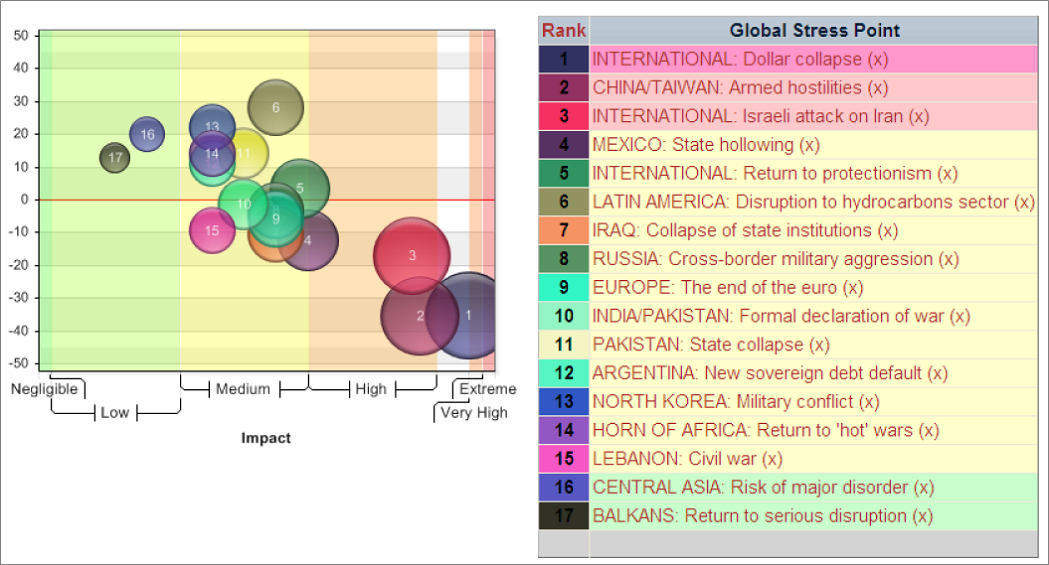
15 Global Stress Points

According to Oxford Analytica, there are 15 "Global Stress Points" ranging from medium to extreme high impact to the entire world. These are listed below ranked by their potential impact.
  1. Dollar Collapse
  2. Taiwan / China Armed Hostility
  3. Israel / Iran Armed Conflict
  4. Mexico State Hollowing
  5. Global Protectionism
  6. Latin America Hydrocarbon Disruption
  7. Iraq State Institutions Collapse
  8. Russia Military Aggression
  9. End of Euro
  10. India / Pakistan War
  11. Pakistan State Collapse
  12. Argentina Sovereign Default 2.0
  13. North Korea Military Conflict
  14. War in North Africa
  15. Lebanon Civil War

(Click to enlarge) Chart Source: Oxford Analytica

It can give us Europeans some comfort that the euro's demise is surprisingly not as big a deal as the Dollar Collapse or a China/Taiwan war.

June 11, 2011

NATO´s Middle East Chess Game

Every good chess player knows that before striking the opponent you want to carefully position your pieces on the board and when ready then unleash hell.
NATO is playing the same game in North Africa and Middle East, toppling down every dictator and replacing it with a military junta as in Egypt with no clear leader and easy to be controlled and replaced if the case, they also get a democratic branding from the support of western countries together with a generous support package to keep things calm among the population.
The choice of countries is not casual, all of them have a strategic relevance either in oil production or logistics, as you can see below Egypt and Yemen are vital to oil supplies, Bahrain is vital to both oil production and logistics and Libya is a perfect replacement for oil from the Middle East should an Iranian blockade take place in Strait of Ormuz, the oil chockpoint where 50% of the world´s seaborne oil transits daily.


Libya has some of the biggest and most proven oil reserves -- 43.6 billion barrels -- outside Saudi Arabia, and some of the best drilling prospects. Libya's oil is unusually "sweet" and "light," fundamentally is high-quality crude oil providing a better value than Saudi one should supplies from the Arabian region be disrupted at any stage. And furthermore Libya is close to Europe making easier to transit oil to the European and American markets while avoiding any possible disruption when the situation in the Middle East will escalate.
No doubt that once that Libyan oil fields will be under NATO control and production will be re-established  a new front of the New Resource War we entered into will be opened most probably directly on the Iranian borders.
Iran is well aware of this and since many years its government has been counteracting to the siege that is being undertaken on its borders. After all Iraq on the western border and Afghanistan on the eastern border are under US control, Saudi Arabia and the Gulf States on his southern border are close US Allies and hosting major military bases. Pakistan on his south eastern border is without leadership and in lack of control while allowing the CIA to do whatever they want on its territory included staging a farsical attack to Osama Bin Laden on the outskirts of their capital. The Iranian northern borders are with Turkey a close US ally and not a good friend of Iran and the Caucasus republics of Russia which aside from Azerbaijan are normally hostile to Iran, the only friendly border at least for now is the one with Turkmenistan which is also vital for Iranian exports to China and Central Asia.
When the tension with Iran will mount and if a full scale war will explode the first victim will be the economy, The Strait of Ormuz will be shut down immediately and oil prices will explode to historical heights, a new great depression will start and as a consequence demand destruction will allow to make up for the shortfalls in production. If NATO plans will succeed Middle East will become a large battlefield for the core resources we covet and we cannot live without. Strange world where you have to wish that a dictator like Gaddafi will live another day.

May 2, 2011

Osama Bin Laden death and Israel war game scenarios

The Pentagon released few hours ago a 5 page powerpoint presentation showing exclusive details of the Abbottabad compound where bin Laden was supposedly killed.


Quite interesting today is also the narration of the event provided by the Iranian Fars News:

TEHRAN (FNA)- The US has killed the Al-Qaeda leader, Osama Bin Laden, in a bid to prevent any possible leakage of intelligence and information about the US-Al-Qaeda joint terrorist operations, a senior Iranian legislator underscored on Monday.
"The West was fully satisfied with bin Laden's performance during the past years and today… it was obliged to kill him to prevent possible leakage of the priceless intelligence that he had," member of the parliament's National Security and Foreign Policy Commission Javad Jahangirzadeh told FNA on Monday.
He mentioned that the West seeks to rebuild its damaged face in the international community, and reiterated that Bin Laden's survival could endanger the interests of the western countries and disclose their past and future clandestine operations.
Jahangirzadeh warned the world countries that the West has hatched a new plot to find new pretexts for invading and occupying the Muslim countries.
Obama announced on Sunday that bin Laden was killed in a US operation in Pakistan.
Obama said he had directed helicopter-borne US armed forces to launch an attack against a heavily fortified compound in Abbottabad, Pakistan on Sunday acting on a lead that first emerged last August.
"A small team of Americans… killed Osama bin Laden and took custody of his body," Obama said.
Senior US officials said that in addition to bin Laden, three adult males died in the raid, two who were believed to be couriers for the Al-Qaeda leader, and one who was said to be one of his adult sons.


And It appears that Iranian television is getting quite anxious for a possible escalation of the conflict in the Middle East:

From PressTV

A considerable number of Israeli warplanes were seen at al-Asad base in Iraq, reported a source close to prominent Iraqi cleric Muqtada al-Sader's group.
The aircraft reportedly included F-15, F-16, F-18, F-22, and KC-10 jet fighters.
The warplanes carried out their week-long exercises at nights, the same source added.
The drills were reportedly aimed at preparing to strike Iran's air defense systems, disrupt Iran's radars and attack targets deep inside Iran.
Iraqi officials had not been notified of the exercises, which were conducted in collaboration with the US military.
The United States maintains numerous bases in Iraq, and the Baghdad government is not involved in any of the military deployments taking place there.