Search This Blog

Showing posts with label Mexico. Show all posts

May 20, 2012

Volcanoes eruptions that could change the world


Recent new of an increased activity of the Santorini Caldera is certainly bad news for crisis-stricken Greece although an eruption of Santorini as tragic as it would be for Greece and the Mediterranean is not the worst event to worry insurance companies and governments.
Below a list of the 6 nightmare volcanoes that could literally trigger catastrophe on a global scale in a relatively short timeframe.


1. KATLA (Iceland)
Last erupted: 1918
Effects of a major eruption: If Katla goes off, its eruption will be 10 times stronger than Eyjafjallajokull's. Katla's larger ash plume would shoot higher in the air and spread over larger areas of Europe for a longer period, with much more devastating effects on air travel and economic trade. An eruption could tip Europe's economy — perhaps even the world's — back into severe recession or a depression.
Likelihood: Fairly high. The two volcanoes, only 12 miles apart, tend to erupt in tandem, and Katla is slightly overdue in its 80-year cycle.
2. CUMBRE VIEJA (La Palma, Canary Islands)
Last erupted:
1971
Effects of a major eruption: In 2001, U.S. and British scientists warned that a major eruption of Cumbre Vieja could cause the enire western flank of the volcano to fall into the sea, creating a "mega-tsunami" in the Atlantic. Traveling at 500 miles per hour, it would wipe out Florida, coastal Brazil, and parts of Europe with waves up to 160-feet high. 
Likelihood:
The scientists say the "year to year probability" of a major eruption is low, but preparations should be taken anyway given the potentially cataclysmic damages.
3. MT. VESUVIUS (Italy)
Last erupted: 1944
Effects of major eruption: Famous for wiping out Pompeii and Herculaneum in 79 A.D., Vesuvius would do much greater damage today. About 3 million people live near the volcano, 600,000 of them in the "red zone." An eruption would kill at least 8,000 people and cause more than $24 billion worth of damage, according to Willis Research Network, which just named Vesuvius the most dangerous volcano in Europe. The ash would change weather patterns in Europe and leave the Naples area a "lifeless desert."
Likelihood: Scientists say Vesuvius is overdue for an explosion.
4. POPOCATÉPETL (Mexico)
Last erupted: 2000
Effects of a major eruption: The third-tallest active volcano in the Northern Hemisphere, Popocatépetl is only 40 miles west of Mexico City and its 18 million inhabitants, and 30 miles east of Puebla, a city of two million. A large eruption could send deadly mudslides into the populous valleys below, creating "catastrophic" loss of life.
Likelihood: After an 80-year dormant period, Popocatépetl is showing signs of activity.
5. MT. TAMBORA (Sumbawa, Indonesia)
Last erupted: 1967
Effects of a major eruption: Tambora erupted in spectacular fashion in 1815 and changed weather patterns around the globe, causing "frosts in Italy in June and snows in Virginia in July, and the failure of crops in immense swaths across Europe and the America." The blow-up killed more than 71,000 people directly, and many more through famine and sickness.
Likelihood: Tambora is still active and, given its history and Indonesia's 222 million inhabitants, closely monitored.
6. YELLOWSTONE "SUPERVOLCANO" (U.S.)
Last erupted: 640,000 years ago
Effects of a major eruption: When the Yellowstone Caldera, or "supervolcano," in Yellowstone National erupts again, it will render a huge swath of North America, from Vancouver to Oklahoma City, uninhabitable. It would have incalculable human and economic consequences. The last eruption of similar magnitude — 73,000 years ago in Sumatra — plunged the entire planet into a decade-long volcanic winter and nearly wiped out the human race.
Likelihood: Geologists see signs that it could be preparing for another major blowout soon, although "soon" could mean thousands of years.

July 8, 2011

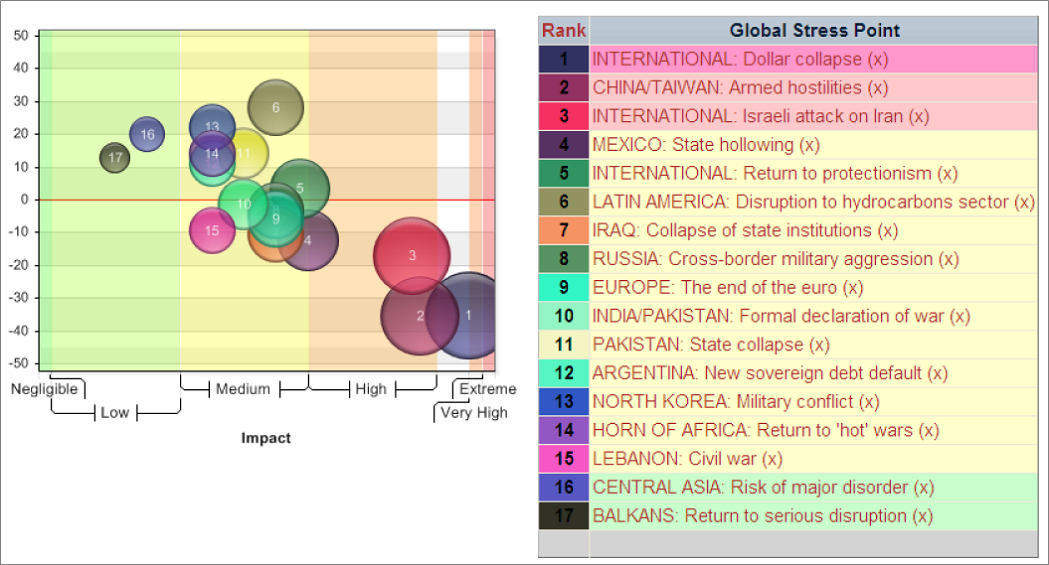
15 Global Stress Points

According to Oxford Analytica, there are 15 "Global Stress Points" ranging from medium to extreme high impact to the entire world. These are listed below ranked by their potential impact.
  1. Dollar Collapse
  2. Taiwan / China Armed Hostility
  3. Israel / Iran Armed Conflict
  4. Mexico State Hollowing
  5. Global Protectionism
  6. Latin America Hydrocarbon Disruption
  7. Iraq State Institutions Collapse
  8. Russia Military Aggression
  9. End of Euro
  10. India / Pakistan War
  11. Pakistan State Collapse
  12. Argentina Sovereign Default 2.0
  13. North Korea Military Conflict
  14. War in North Africa
  15. Lebanon Civil War

(Click to enlarge) Chart Source: Oxford Analytica

It can give us Europeans some comfort that the euro's demise is surprisingly not as big a deal as the Dollar Collapse or a China/Taiwan war.

April 28, 2009

Swine Flu: Global Crisis Part III

The modality of the Swine flu infection does not make sense at all.
The first question is how almost simultaneouly the same flu appeared in Mexico and US, let us suppose for a moment the Americans were infected in Mexico few days ago and travelled back to US, should they not be dying like the Mexicans, how is possible that simply going back to US they suddenly get a mild version of the flu.
If this is not the case, then we have more than one epicentre of the flu, a mild one in US and a dangerous one in Mexico, then again why New Zealenders, Europeans and Canadians infected in Mexico go back to their countries with a mild flu.
It seems like there are two versions a weaponized one unleashed in Mexico and a controlled one unleashed in US.
Let's suppose for a second that it was a plan to spread chaos all over the world.
Let us ignore for the moment who did it but rather why it was done.
What is to be earned from adding to a financial crisis a pandemic crisis on the top.
Well a lot maybe if they are aware that the end of the game is closing, if the financial meltdown put together with the oil scarcity that will be on us soon is going to cause turmoil in the society, what better way to advocate draconian measures with the justification of preventing a pandemic outbreak.
Second reason we read few days ago the following:

Al-Naimi Says Saudi Oil Output Below Target; Stockpiles to Fall

Christian Schmollinger and Shigeru Sato, Bloomberg

Saudi Arabia, OPEC’s biggest oil exporter, is producing less crude than its target and global stockpiles are likely to decline, according to Oil Minister Ali al-Naimi.
The country is producing less than 8 million barrels of crude a day, al-Naimi told reporters today in Tokyo, where he is attending a meeting of Asian energy ministers. Stockpiles “will come down eventually,” he said.
U.S. stockpiles have climbed to the highest since September 1990 even as Saudi Arabia leads the Organization of Petroleum Exporting Countries’ efforts to implement a 4.2 million barrel a day reduction in oil output from the group’s September levels. The country is producing 7.79 million barrels a day, less than its target of 8.1 million barrels a day.(25 April 2009)


The first industry affected from this outbreak is travel, notoriously the biggest user of oil.
Is it an attempt to stop the hemorragy temporarily or is an attempt to cripple the industry and therefore the global mobility.
In both cases financial distress will be high and a further destabilization force will cripple the global economy, though it will be much less traumatic than waking up three months from now with no gasoline and with a total economic collapse.

Going back to the swine flu: the first question media asks normally is HOW, this time we do not have a clue yet how this people got infected and how the flu spreads, everyone is waiting to understand what CDC and WHO will say or better what justification they will engineer for us to avoid embarassment.

Some news and doubt though are surfacing, this time it appears more people than usual is struck by such an odd series of events which inevitably bring to suspicions.

According to a source known to former NSA official Wayne Madsen, “A top scientist for the United Nations, who has examined the outbreak of the deadly Ebola virus in Africa, as well as HIV/AIDS victims, concluded that H1N1 possesses certain transmission “vectors” that suggest that the new flu strain has been genetically-manufactured as a military biological warfare weapon.
Madsen claims that his source, and another in Indonesia, “Are convinced that the current outbreak of a new strain of swine flu in Mexico and some parts of the United States is the result of the introduction of a human-engineered pathogen that could result in a widespread global pandemic, with potentially catastrophic consequences for domestic and international travel and commerce.”
However, it’s important to stress that it is far too early to make this assumption.
Watch out closely the events this week!