Search This Blog

Showing posts with label global. Show all posts

February 23, 2013

Global Risk Landscape 2013


The World Economic Forum created an intriguing set of 50 'global risks'. The global risk that respondents rated most likely to manifest over the next 10 years is severe income disparity, while the risk rated as having the highest impact if it were to manifest is major systemic financial failure. There are also two risks appearing in the top five of both impact and likelihood – chronic fiscal imbalances and water supply crisis.

The most 'worrying' risks are up and to the right (higher probability and high impact).

Chronic Fiscal Imbalances tops the chart along with Sever Income Disparity.


The Top 5 Global Risks by Impact have evolved notably over the past few years.


The Top 5 Global 'Most Likely' Risks have also evolved but Economic remains the most dominant.


February 21, 2013

Italian Elections increase doubts over long term reforms

Italians head to the polls on February 24-25 and never before the political scenario has been so chaotic and appalling.

We are witnessing new political movements like the 5 Stars movement climbing up to third place in a matter of months and never before we have seen Germany actively entering the Italian political debate to try and keep Berlusconi at bay.
 
All this is adding up to financial uncertainty on the future of Italy and at large of the Eurozone.

Pier Luigi Bersani, who heads the centre-left PD was considered the assumed new prime minister just a few short weeks ago, at least in the Chamber (the lower house of parliament).

It's all up in the air now as Silvio Berlusconi's PDL has staged a massive rally in the polls.

Berlusconi has been on a rampage lately blaming Germany and Chancellor Angela Merkel for the unemployment problems in Italy, promising to refund the hated IMU (property tax) and more exotically declaring that tax evasion is justified.

Beppe Grillo's Movimento 5 Stelle (Five Star Movement) which has been largely ignored in the Italian press has been wildly popular at rallies. Grillo has a chance to come in second place.

Mario Monti, who heads the centrist Con Monti per l’Italia (With Monti for Italy) coalition, is running a very distant 4th.

Poll Blackouts

Officially, pollsters cannot post poll results in a blackout period before the election. That blackout period started February 9. Below Reuters' 8th of February polls.


Those results are misleading because they do not include undecided voters, and the undecided vote is a very large 20-25 percent!

With such little difference between Berlusconi and Bersani, and with huge rallies for Beppe Grillo and Berlusconi, any outcome is possible.

Germany Warns Against Berlusconi

Of potentially more importance, Berlin Warns Italians against Berlusconi

Here are a few examples from the story.

German Finance Minister Wolfgang Schäuble reportedly said (but later denied) "Silvio Berlusconi may be an effective campaign strategist, but my advice to the Italians is not to make the same mistake again by re-electing him."

Polenz, a senior member of Chancellor Angela Merkel's Christian Democrats, said: "Italy needs political leaders who stand for the future. Berlusconi is certainly not one of them."

One Italian bank even went so far this week as to issue a report arguing that a Berlusconi election would almost certainly force the country to apply for emergency bailout aid from the EU. Mediobanca, Italy's largest investment bank, wrote that "a last-minute Berlusconi victory would scare the market sufficiently to put pressure on the spread."

"Silvio the Savior"

Spiegel reports Berlusconi's Faithful: 'Only Silvio Can Save Italy'
Adoration of Berlusconi in Italy remains widespread. In the parallel universe occupied by his followers, there is no room for doubt about Berlusconi and lines are clearly drawn. Silvio is good and the others are bad.

These fans gather at his speeches, like the Saturday rally in Palermo, where thousands crowded into the venerable Teatro Politeama. There were women in long fur coats and fine gentlemen in three-piece suits. Dock workers like Ferrante squeezed with them through the entrance, everyone pushing and shoving each other like adolescents at a rock concert. The hundreds who didn't make it in must stand outside.

Fully a quarter of Italians are prepared to vote for Berlusconi again. It is an astounding degree of homage paid to man who faces allegations of abuse of power and bribery; who faces the scandal surrounding the underage escort Karima el-Marough, alias Ruby Rubacuori; who has been blasted for blatantly misogynistic comments; and who broke many promises as prime minister. Instead, the opposition, left-leaning judges and even the Germans are blamed for all that is not right with Italy.
At best, Bersani will win the Chamber and lose the Senate. That would likely result in a hung parliament.

Anti-German sentiment in Italy is high already. The entrance of German politicians into the battle may fuel that sentiment in a major way.

It is conceivable "Silvio the Savior" pulls off a stunning upset win in both the Chamber and Senate, but a Senate victory would still require a coalition (no party will come close to a majority).

It may be difficult if not impossible for any party to form a Senate coalition if Monti's party does poorly as expected.

Regardless Berlusconi there seems to be no good outcome for Italy.

January 13, 2013

2013 Economic Freedom Report highlight Italy's troubles

The appalling state of Italian economy is no longer getting international headlines but the slide of the county toward third world standards is continuing unabated.
The new 2013 report on Economic Freedom has been published; a full report can be found here and again Italy's ranking is a disaster for a major economy.

On the overall score Italy is ranking 83rd which by itself is an appalling result for a major developed economy, positioning itself below Uganda and Sri Lanka.

But when it comes to Freedom from Corruption Italy manage to score an appalling score of 39 together with Ghana and Macedonia.


Below some extracts from the report delving into an analysis of Italy's shortcomings:

The foundations of economic freedom remain weak in the absence of an efficient judicial framework to provide effective and timely resolution of cases. Corruption, often involving government officials, is a growing concern, severely undercutting confidence and trust in the government.

As per the rule of law and corruption Italy is faring among the worst countries, below the motivation for such low ranking:

Property rights and contracts are secure, but court procedures are extremely slow. Many companies choose to settle out of court. The legal system is vulnerable to political interference. Widespread corruption has bred a culture of lawlessness and tax evasion and has weakened respect for the judiciary. Enforcement of intellectual property rights is below developed-country standards.
And when it comes to attracting investments:

Regulatory complexity causes delays and increases the cost of entrepreneurial activity. Completing licensing requirements takes over 200 days and costs more than the level of average annual income. Serious labor market rigidities constrain job growth, and the informal labor market accounts for a large proportion of employment. Stagflation engendered by the eurozone crisis presents monumental monetary policy challenges.


Read more about Italy Economy.
        See more from the 2013 Index.


OVERALL SCORE BY COUNTRY:


Hong Kong 89.3
Singapore 88
Australia 82.6
New Zealand 81.4
Switzerland 81
Canada 79.4
Chile 79
Mauritius 76.9
Denmark 76.1
United States 76
Ireland 75.7
Bahrain 75.5
Estonia 75.3
United Kingdom 74.8
Luxembourg 74.2
Finland 74
The Netherlands 73.5
Sweden 72.9
Germany 72.8
Taiwan 72.7
Georgia 72.2
Iceland 72.1
Lithuania 72.1
Austria 71.8
Japan 71.8
Macau 71.7
Qatar 71.3
United Arab Emirates 71.1
Czech Republic 70.9
Botswana 70.6
Norway 70.5
Jordan 70.4
Saint Lucia 70.4
South Korea 70.3
The Bahamas 70.1
Uruguay  69.7
Colombia 69.6
Armenia 69.4
Barbados 69.3
Belgium 69.2
Cyprus 69
Slovakia 68.7
Macedonia 68.2
Peru 68.2
Oman 68.1
Spain 68
Malta 67.5
Hungary  67.3
Costa Rica  67
Mexico 67
Israel 66.9
Jamaica  66.8
El Salvador  66.7
Saint Vincent and the Grenadines 66.7
Latvia 66.5
Malaysia  66.1
Poland 66
Albania 65.2
Romania 65.1
Bulgaria 65
France 64.1
Rwanda 64.1
Thailand  64.1
Dominica 63.9
Cape Verde 63.7
Kuwait 63.1
Portugal 63.1
Kazakhstan 63
Turkey 62.9
Montenegro 62.6
Panama  62.5
Trinidad and Tobago 62.3
Madagascar 62
South Africa 61.8
Mongolia 61.7
Slovenia 61.7
Croatia 61.3
Ghana 61.3
Paraguay  61.1
Uganda 61.1
Sri Lanka 60.7
Italy 60.6
Saudi Arabia 60.6
Namibia 60.3
Guatemala  60
Burkina Faso 59.9
Azerbaijan 59.7
Dominican Republic 59.7
Kyrgyz Republic  59.6
Morocco 59.6
Lebanon 59.5
The Gambia 58.8
Zambia 58.7
Serbia  58.6
Cambodia 58.5
Honduras  58.4
The Philippines 58.2
Tanzania 57.9
Gabon 57.8
Brazil 57.7
Benin 57.6
Belize 57.3
Bosnia and Herzegovina 57.3
Fiji 57.2
Swaziland 57.2
Samoa 57.1
Tunisia 57
Indonesia 56.9
Nicaragua  56.6
Vanuatu 56.6
Mali 56.4
Tonga 56
Kenya 55.9
Yemen 55.9
Moldova 55.5
Senegal 55.5
Greece 55.4
Malawi 55.3
India 55.2
Nigeria 55.1
Pakistan  55.1
Bhutan 55
Mozambique  55
Seychelles 54.9
Egypt 54.8
Côte d'Ivoire  54.1
Djibouti 53.9
Niger 53.9
Guyana 53.8
Papua New Guinea 53.6
Tajikistan 53.4
Bangladesh  52.6
Cameroon 52.3
Mauritania 52.3
Suriname 52
China 51.9
Guinea 51.2
Guinea-Bissau 51.1
Russia 51.1
Vietnam 51
Central African Republic 50.4
Nepal 50.4
Laos 50.1
Micronesia 50.1
Algeria 49.6
Ethiopia 49.4
Liberia 49.3
Burundi 49
Maldives 49
Togo 48.8
Sierra Leone 48.3
Haiti 48.1
Belarus 48
São Tomé and Príncipe  48
Bolivia 47.9
Lesotho 47.9
Comoros 47.5
Angola 47.3
Ecuador 46.9
Argentina 46.7
Ukraine 46.3
Uzbekistan 46
Kiribati 45.9
Chad 45.2
Solomon Islands 45
Timor-Leste 43.7
Republic of Congo  43.5
Iran 43.2
Turkmenistan 42.6
Equatorial Guinea 42.3
Democratic Republic of Congo 39.6
Burma 39.2
Eritrea 36.3
Venezuela  36.1
Zimbabwe 28.6
Cuba 28.5
North Korea 1.5

January 10, 2013

Global Manufacturing Ranking

The leaders of global manufacturing are changing rapidly, China, India and Russia are rising and Germany, Japan, UK, and Canada are sliding. The following chart simplifies the evolution of global manufacturing economies over the last four decades.

December 16, 2012

How successful is your country?


Goldman in his recent study notes that the competitive strengths of companies often stem from the advantages of the countries they reside in.

These include a combination of resource availability (food, energy, mining and others), demographics, trade positioning, infrastructure quality and above all, the presence of strong, inclusive institutions that encourage innovation.

So, what follows is Goldman's attempt to map the various success drivers of the world’s countries.

Goldman divides the drivers into four categories:

Innovation
Patents per capita, R&D as a percentage of GDP, venture capital as a percentage of GDP and the birth rate of companies.

Institutions
Confidence in national institutions, days aken to enforce a contract, the cost of starting a business and the GINI co-efficient that measures income inequality.

Resources
Net crude oil exports/(imports) as a percentage of consumption, per capita food surplus/(deficit), copper + iron ore + aluminum surplus/(deficit) and retirees as a percentage of population.

Infrastructure
Transport (airports per capita, railways per sq km), electricity production per capita and internet penetration.
Italy again scores among the worst countries in Europe just after Greece; in brief its institutions are weak, Internet penetration is appalling and when it comes to enforce contracts; it is the worst country in Europe and far behind many third world countries like Nigeria or Kenya who rank much better than Italy on this aspect.


The overall scorecard...


and a close up on Europe... (click image for huge version)


Source: Goldman Sachs

November 21, 2012

Key Global Events

Interesting chart with all major incoming events for the next 5 years.


Election Events...


and the next 12 months events:


Source: SocGen

November 14, 2012

Global Economic Indicators

Congratulations to Italy for scoring the worst GDP growth and worst unemployment, bets are open won how soon Russia and India will leave Italy behind.

economy

November 11, 2012

Heather Brooke: My battle to expose government corruption

Our leaders need to be held accountable, says journalist Heather Brooke. And she should know: Brooke uncovered the British Parliamentary financial expenses that led to a major political scandal in 2009. She urges us to ask our leaders questions through platforms like Freedom of Information requests -- and to finally get some answers.
Worth listening carefully!


October 23, 2011

Global Debt Clock

From the Economist:
The clock is ticking. Every second, it seems, someone in the world takes on more debt. The idea of a debt clock for an individual nation is familiar to anyone who has been to Times Square in New York, where the American public shortfall is revealed. Our clock shows the global figure for all (or almost all) government debts in dollar terms.

Does it matter? After all, world governments owe the money to their own citizens, not to the Martians. But the rising total is important for two reasons. First, when debt rises faster than economic output (as it has been doing in recent years), higher government debt implies more state interference in the economy and higher taxes in the future. Second, debt must be rolled over at regular intervals. This creates a recurring popularity test for individual governments, rather as reality TV show contestants face a public phone vote every week. Fail that vote, as the Greek government did in early 2010, and the country can be plunged into imminent crisis. So the higher the global government debt total, the greater the risk of fiscal crisis, and the bigger the economic impact such crises will have.


October 5, 2011

Paying the price

The third episode of Meltdown looks at how the victims of the 2008 financial crash fight back. A protesting singer in Iceland brings down the government; in France a union leader oversees the kidnapping of his bosses; and thousands of families are made homeless in California.


October 2, 2011

A global financial tsunami

In the second episode of Meltdown, we look at how the financial tsunami swept the world. We hear about a renegade executive who nearly destroyed the global financial system and the US treasury secretary who bailed out his friends.
Henry 'Hank' Paulson, the former CEO of Goldman Sachs and later an economic advisor to the US government; refused to bail out global financial services firm - the Lehman Brothers. Paulson said it was not the role of government to save private businesses.
Lehman's failure had repercussions around the world. Millions of people lost their life savings. Pension plans were decimated.
Christine Lagarde, the French finance minister at the time and a close friend of Paulson's, publicly described Paulson's decision on Lehman "horrendous".
Markets from London and Paris to Shanghai fell. An epidemic of fear caused the world's major banks to stop lending, ending the year in protests and industrial action.


July 8, 2011

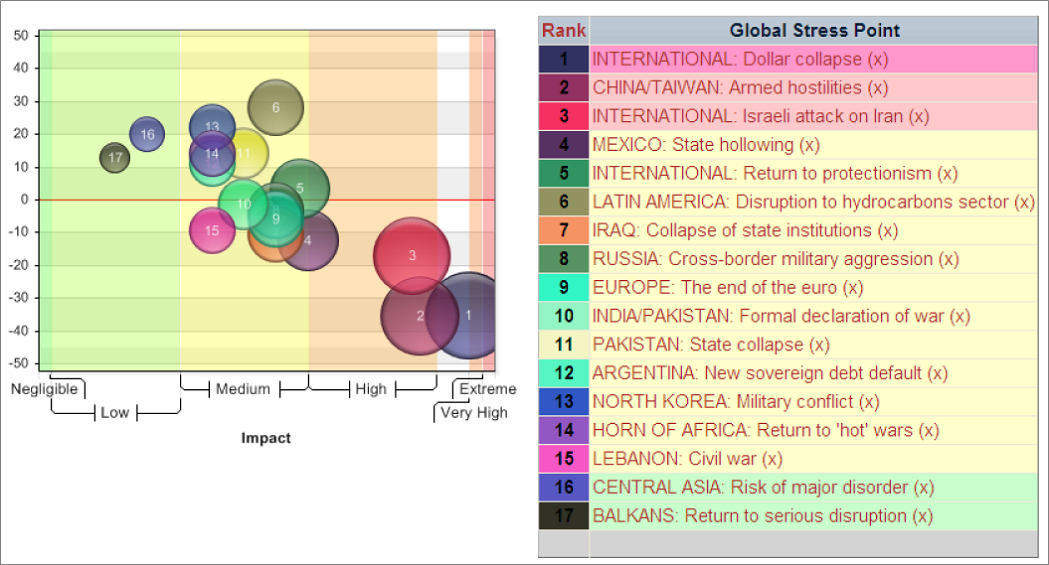
15 Global Stress Points

According to Oxford Analytica, there are 15 "Global Stress Points" ranging from medium to extreme high impact to the entire world. These are listed below ranked by their potential impact.
  1. Dollar Collapse
  2. Taiwan / China Armed Hostility
  3. Israel / Iran Armed Conflict
  4. Mexico State Hollowing
  5. Global Protectionism
  6. Latin America Hydrocarbon Disruption
  7. Iraq State Institutions Collapse
  8. Russia Military Aggression
  9. End of Euro
  10. India / Pakistan War
  11. Pakistan State Collapse
  12. Argentina Sovereign Default 2.0
  13. North Korea Military Conflict
  14. War in North Africa
  15. Lebanon Civil War

(Click to enlarge) Chart Source: Oxford Analytica

It can give us Europeans some comfort that the euro's demise is surprisingly not as big a deal as the Dollar Collapse or a China/Taiwan war.

May 29, 2011

Greenhouse gas emissions reach highest point ever

And while the global economy is heading toward a double dip recession if we want to be optimists, the relentless burning of fossil fuels is continuing regardless of the crisis, an interesting new report on global warming:

Greenhouse gas emissions increased by a record amount last year, to the highest carbon output in history, putting an end to hopes of holding global warming to safe levels according to unpublished estimates from the International Energy Agency.

This also shows the most serious global recession in80 years has had only a minimal effect on emissions, contrary to some predictions.

Last year, a record 30.6 gigatonnes of carbon dioxide was poured into the atmosphere, mainly from burning fossil fuel – a rise of 1.6Gt on 2009, according to estimates from the IEA regarded as the gold standard for emissions data.

April 28, 2011

Global Military Expenditure

Updated graph on global military expenditure, USA is still the top gun with a gigantic 46.5%.

March 25, 2011

Global Market Capitalization

China has just passed Japan as a percentage of total global market capitalization. Admittedly, this is crisis-driven, but the trend is clear and important.
Interesting to see how Spain even if in decline has moved above Italy which has lost considerably in the last 6 years, moving from one of the first 8 countries to an abysmal last among large economies.

Worldmktcaptable

March 5, 2011

Mobile Operating System market

Interesting to see how developing countries differentiate themselves in choosing a Nokia platform:


January 19, 2011

Global Unemployment

Latest figures on global unemployment, current rate globally is 7%


while underemployment is currently at 19%


for full details please visit: http://www.gallup.com/poll/145487/Gallup-Global-Employment-Tracking.aspx

May 7, 2009

Population and Peak Oil: where is the debate!

These days certainly we do have an abundance of gloom and doom subjects: the latest in the hit parade, swine flu is joining global warming and recession/depression at the forefront of media discussion.
It remains to understand though why the two key actors Population and Peak Oil are hardly discussed.
Population and Peak Oil are the source of every imbalance we are witnessing today; Global Warming, Water and Food depletion, Wars, Economical Crisis, pandemic etc. etc. are all consequences of these two strongly interlaced factors.
It is true that recently Peak Oil has started to be acknowledged by the oil experts and oil corporations that until 1 year ago were strongly calling everyone proposing the theory a lunatic.
Total, Aramco and others have finally acknowledged the fact that peak oil is here and that we probably peaked in 2005.
The excellent work of Matthew Simmons and Colin Campbell at explaining this potentially catastrophic issue is finally being considered more broadly by the establishment even though a large scale acknowledgment and discussion is still missing.
Population on the opposite is still widely ignored or diminished of magnitude, being the most delicate of the issues is being addressed with soft tones and occasional innuendos that are preventing any serious and drastic remedy. It is quite sad considering that population was a serious discussion in the 60s and 70s when the Club of Rome issued the famous report: The Limits to Growth.
Since then the issue has not been revisited anymore and has fallen in the sands of oblivion.
If the economy and corporations need always more and more clients to increase their revenue; growth in all its form cannot be bad! Right!
Well it is wrong actually! Unlimited and undisciplined growth in a world with finite resources is a monstrosity and a disaster being manufactured. We have had an explosion of population in the last 100 years due to the abundant and cheap oil.
Abundant and cheap oil allowed for the Green revolution which increased 10 fold the food output, allowed for transportation, manufacturing and energy to be readily available for a growing number of people, but now we are at a turning point in human history, oil is no longer abundant and cheap anymore. An oil shock according to many experts is only months away and a gas and food and water shock could follow in various parts of the world in the following years.
Controlling the world's population explosion is now more than ever essential to avoid an armageddon scenario unfolding in the following years.

The obstacles to control the population are first of all moral and political. Democracy and human rights by themselves are blocking any attempt to tackle this enormous problem, a new rethinking of what is a a sustainable democracy and what are human rights is longely due.

Human rights were proclaimed in a very different world from the one we are entering into now.
Western civilization was controlling the entire planet and consuming 90% of the resources.
Today hugely populated countries as China and India have entered the game as superpowers and they joined the party when only scraps have been left on the table.
If the population of China would live according to European standards we would need the resources, food and water of an extra 6 planets.
They will have to compete with the rest of us for those last scraps.

Democracy will not survive when the first signs of resource and social stress will show up and human life in the following years will become much cheaper.
Two paths are available either we continue on this road and then we will face resource wars, disasters and pandemics unleashing each year; or we accept that current population levels are unsustainable that our ant community has grown too big and too fast and that we need to rebalance the population level even with draconian measures. Ignoring the reality or being indolent in addressing it will only increase the price we will have to pay in terms of lives and social collapse when nature will take care of it soon!

Some scary things are happening right now and I will report them in following posts! Be tuned!