Search This Blog

Showing posts with label Iraq. Show all posts

March 30, 2015

US weapon of mass turmoil: ISIS

For those who always found ISIS' rise to terrorism stardom a little suspicious; we are learning from the Washington Post that U.S. is directly supplying and aiding ISIS in Iraq. These accusations are coming from senior military figures within the Iraqi army.

“Everybody knows that the Americans are dropping supplies to Daesh,” said Brig. Gen. Abed al-Maliki, a senior Iraqi army commander based in the city of Samarra, about 80 miles north of Baghdad, using another term for the Islamic State.

What’s more, he said, during some of the fiercest fighting around Samarra last year, U.S. Special Operations forces dropped behind enemy lines to assist Islamic State militants.

“They came in with parachutes, and they were helping to bomb the city,” he said.

U.S. airstrikes against the Islamic State, he contended, are probably just a cover for efforts to support the group.

“It’s just a show,” he said, sitting in the city’s army command headquarters. “If the Americans want to finish something, they will finish it. If they wanted to liberate Iraq, they could.”
 – From the Washington Post article, In Fight for Tikrit, U.S. Finds Enemies on Both Sides of the Battle Lines, March 27, 2015


Now the real reason behind the USA strategy can be simply a divide and conquer strategy in which control of the region is assured through relentless war boosting the revenue of american defense corporations supplying all combatants.
My theory is that ISIS is becoming a new mercenary force deployed according to the contingencies all over the arab world to create havoc and get rid of unwanted leaders with the added convenience that being a muslim enemy force can also avoid the side effects of christian forces on muslim soil unless requested ad hoc by either the victims or the butchers.

December 12, 2011

Middle East War Games

As mentioned previously the war machine is warming up in the Middle East after toppling one government after another in North Africa the final Prize remains Iran although it was unclear if they would have waited for Syria to fall before launching an attack on Iran, it could be possible they are contemplating a two fronts attack on the last remaining obstacles to hegemonic control of Middle East and Central Asia resources.

US troops deploying on the Jordan-Syrian Border:

According to one Jordanian military officer who asked to remain anonymous, hundreds of soldiers who speak languages other than Arabic were seen during the past two days in those areas moving back and forth in military vehicles between the King Hussein Air Base of al-Mafraq (10 km from the Syrian border), and the vicinity of Jordanian villages adjacent to the Syrian border, such as village Albaej (5 km from the border), the area around the dam of Sarhan, the villages of Zubaydiah and al-Nahdah adjacent to the Syrian border.

Another report received from our source in Amman identified an additional US-NATO Command Center in “al-Houshah,’ a village near Mafraq.
An Iraqi journalist source in London provided us with the following related information:
“Some of the US forces that left the Ain al-Assad Air base in Iraq last Thursday, did not come back to the USA or its base in Germany, but were transferred to Jordan during the evening hours.”
The above information was further corroborated by correspondent and advisor Nizar Nayouf who interviewed an employee in the London-based office of Royal Jordanian Airlines:
“At least one US aircraft carrying military personnel landed in the Prince Hassan Air base located about 100 km to the east of the city of Al-Mafraq.”
In the meanwhile Iran is starting its preparation to the incoming war:

A member of the Iranian parliament's National Security Committee said on Monday that the military was set to practise its ability to close the Gulf to shipping at the narrow Strait of Hormuz, the most important oil transit channel in the world, but there was no official confirmation.

The legislator, Parviz Sarvari, told the student news agency ISNA: "Soon we will hold a military manoeuvre on how to close the Strait of Hormuz. If the world wants to make the region insecure, we will make the world insecure."

August 21, 2011

Libya's war close to end, who is next?

It appears the unreported and unofficial war in Libya could be close to an end. It appears, according to mainstream media, rebels are close to the capital and our fearless leader Gaddafi is close to throwing the towel and leave the ring. Regardless of the reliability of this information is clear that strong powers want the war ended and fast.
Together with the latest news from Syria this is indicating we are getting closer to the turning point I was mentioning at the start of the Libyan war.
Once Libya will be under control and it could be a matter of months things will turn nasty, once the Libyan oil will be on the grid again the situation will unravel fast. It seems we are facing a crisis escalation on both the military and financial side, the financial domino both in Europe and the USA is falling and a major rush to get control of Libyan oil reserves is becoming imperative at this point.
To understand this chess game is possible only if we consider the broader picture, the financial crisis, the war in Libya and the unrest in the Middle East and North Africa are all connected pieces of a bigger puzzle.
The reality is that the financial system has reached a terminal stage, leverage is getting harder and harder and cash injection has reached a structural limit, there is not enough money to bailout the black hole of debt created and  peak oil is already here making impossible to go back to growth and inflate ourselves out of this mess.
Growth is not available because the current system has reached the maximum capacity and is deflating fast while debt has reached levels never seen before in history.
There are few options left either declare insolvency and bring the entire system down or go to war and make harsh austerity a war necessity for the population while stealthily bankrupting the western world and all its creditors.
In this situation there is a rush to control and manage the reduced resources available and gain the preservation or well reduced deterioration of the population's standard of life together with a competitive advantage over other nations who are not so blessed of controlling those essential resources.
It is a strategic imperative for every nation to get access by any necessary mean to strategic resources whose lack would bring to an halt the economy and its democracy.
No wonder China is getting very jittery lately although regardless of its strategic links with Iran will not react aside from verbal shows when the situation will escalate.
After all should China lose access to the western world markets and treasuries It would risk economical and social collapse, they will play along with US and EU since they are into the same game, they will get concessions due to their symbiotic relation with the West after all the West still need China's cheap productive capacity but they are caught into the same game all right.
The next target is clearly Syria, which has been thrown into chaos already although with this week clear innuendo from Obama is clearly the next regime to be toppled down as soon as the major Libyan headache will be solved.
The only major variable in this scenario is Turkey, the situation is very volatile at this moment with the confrontation between the Muslim Erdogan's government and the secular Turkish Army, how Turkey, a member of NATO will play this game is a major diplomatic variable to be considered.
One thing is clear Middle East and Central Asia is the prize in this dangerous power game and this could escalate quickly if financial distress will raise in the following months.



July 8, 2011

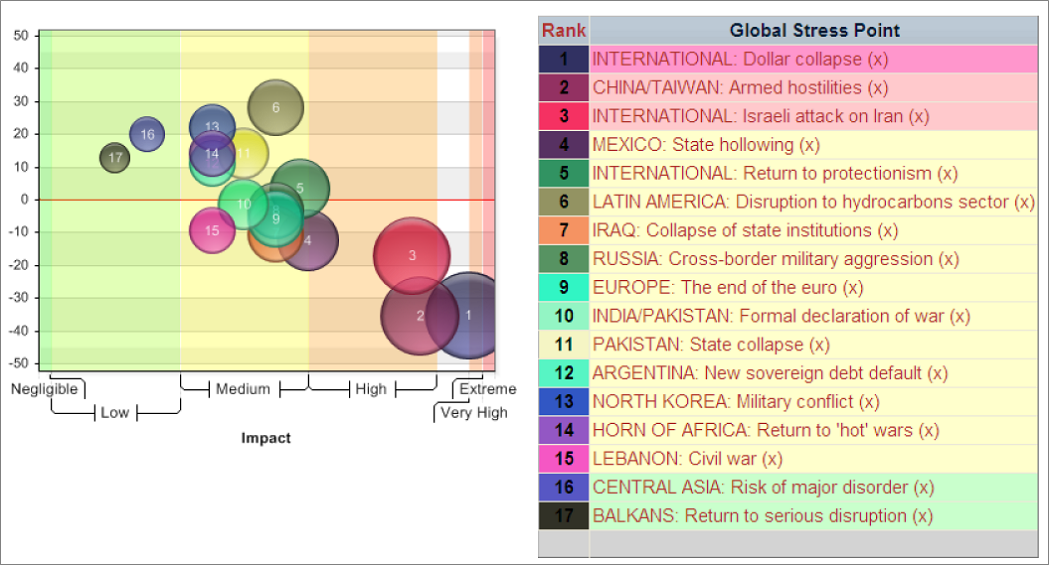
15 Global Stress Points

According to Oxford Analytica, there are 15 "Global Stress Points" ranging from medium to extreme high impact to the entire world. These are listed below ranked by their potential impact.
  1. Dollar Collapse
  2. Taiwan / China Armed Hostility
  3. Israel / Iran Armed Conflict
  4. Mexico State Hollowing
  5. Global Protectionism
  6. Latin America Hydrocarbon Disruption
  7. Iraq State Institutions Collapse
  8. Russia Military Aggression
  9. End of Euro
  10. India / Pakistan War
  11. Pakistan State Collapse
  12. Argentina Sovereign Default 2.0
  13. North Korea Military Conflict
  14. War in North Africa
  15. Lebanon Civil War

(Click to enlarge) Chart Source: Oxford Analytica

It can give us Europeans some comfort that the euro's demise is surprisingly not as big a deal as the Dollar Collapse or a China/Taiwan war.

June 27, 2011

$20 billion air conditioning bill for US troops

Today, NPR reported a stunning story: Air conditioning in Iraq and Afghanistan costs $20.2 billion annually.
That’s more than NASA’s budget. It’s more than BP has paid so far for damage during the Gulf oil spill. It’s what the G-8 has pledged to help foster new democracies in Egypt and Tunisia.
To power an air conditioner at a remote outpost in land-locked Afghanistan, a gallon of fuel has to be shipped into Karachi, Pakistan, then driven 800 miles over 18 days to Afghanistan on roads that are sometimes little more than “improved goat trails,” [retired Brigadier General Steven] Anderson says. “And you’ve got risks that are associated with moving the fuel almost every mile of the way.”

In 2010, the US spent $165.1 billion in Iraq and Afghanistan, according to the Congressional Research Service. This means roughly 12% of expenditures were on air conditioning.
Fuel is not only a budget breaker, it’s a logistical nightmare that can cost lives. Anderson, who manged operational logistics for Gen. David Patreaus in Iraq, explained the impacts of air conditioning on a commander:

“He literally has to stop his combat operations for two days every two weeks so he can go back and get his fuel. And when he’s gone, the enemy knows he’s gone, and they go right back to where they were before. He has to start his counter-insurgency operations right back at square one.”

January 28, 2011

3 Trillion- Dollar War

What are the direct and indirect costs of a war and who profits most from it, a nice chart on the ballooning war in Iraq and its financial impact:

full size image available here