Search This Blog

Showing posts with label dollar. Show all posts

August 22, 2012

Velocity of Money

Velocity of money is the  frequency with which a unit of money is spent on new goods and services.   It is a far better indicator of economic activity than GDP, consumer prices, the stock market, or sales.  In a healthy economy, the same dollar is collected as payment and subsequently spent many times over.  In a depression, the velocity of money goes catatonic.  
Velocity of money is calculated by simply dividing GDP by a given money supply.  The following is the velocity of money since Great Depression, sometimes a picture is worth more than thousand words and the picture is quite clear here.
The situation here is worst than the Great Depression and World War II and deteriorating fast.


June 3, 2012

Drugs, Dollars and Banks

Drug is a precious commodity but also a powerful social disruptor able to wreak havoc in a society and weaken it; it was used in the past in China during the Opium Wars to weaken the Qing Dinasty and accumulate huge profits for Britain or today in Afghanistan and many other Latin and African countries to fragment and destroy the social fabric and control its production and profits.


Political use of drugs

Drugs are a powerful weapon when deployed on a population, its many advantages include:
  • docility of addicted population
  • increase of economic indebtedness
  • increased stress on health services and social services
  • social fabric fracture and degradation
  • massive outflow of capitals to foreign banking systems and suppliers
  • increased corruption and illegality
  • creation of an indentured service system
Drugs have the same effect of war mines on a population, their purpose at war is not to kill in many cases but simply cripple people in order to create a taxing burden for the society.

Drugs have many similarities with oil as well; the reserve currency for drug smuggling and transactions is the dollar, every drug transaction is practically paying a fee to the US Federal Reserve, not surprising that such a trade is protected by concerned governments all over the world.
If the Iraqi wars were fought for oil; Afghanistan was in part fought for opium and it started shortly after the Talibans started to destroy opium fields and banned drugs trade.

This is past history and it can explain why war to drugs is and will always be a lost war, no one is really interested to fight such a profitable business regardless of occasional moral proclamations broadcasted on TV.

New Drugs economy

The future of drugs is the new synthetic trade growing rapidly and evolving technologically to become independent from natural sources.

If the new Canadian producers of synthetic drugs will succeed the economical landscape of drugs could change rapidly in the following years, removing the difference between producers and consumers countries and allowing for mass production of drugs without need of natural resources and reducing the time to market and cross-border illegal trade.

Still now though who is profiting the most from drugs is the banking system who launder the profits and reap the hidden tax of the dollar as a reference currency in the case of USA.
Let us not forget that when the Euro was introduced a 500 Euro bill was created specifically for the necessities of smugglers, cartels and bankers, at that time the major aspiration for the Euro was to replace the dollar as preferred currency of choice for drug barons, arm dealers and robber barons.

The Guardian today added an interesting outlook (brief excerpt below) on where and how profits from this trade are done.
It will not raise any parliamentary discussion or moral debate on the war to drugs, the issue has disappeared slowly and silently from public debates while drugs have been more and more popularized by the media as socially acceptable if not socially cool, after all banks are drowning in debt, economies are collapsing then what better way to fill the empty coffers with an increased number of addicts and stupor their futures and fortunes away.

From The Guardian:
 
The vast profits made from drug production and trafficking are overwhelmingly reaped in rich "consuming" countries – principally across Europe and in the US – rather than war-torn "producing" nations such as Colombia and Mexico, new research has revealed.
The most far-reaching and detailed analysis to date of the drug economy in any country – in this case, Colombia – shows that 2.6% of the total street value of cocaine produced remains within the country, while a staggering 97.4% of profits are reaped by criminal syndicates, and laundered by banks, in first-world consuming countries.

Gaviria and Mejía estimate that the lowest possible street value (at $100 per gram, about £65) of "net cocaine, after interdiction" produced in Colombia during the year studied (2008) amounts to $300bn. But of that only $7.8bn remained in the country.
"It is a minuscule proportion of GDP," said Mejía, "which can impact disastrously on society and political life, but not on the Colombian economy. The economy for Colombian cocaine is outside Colombia."

The mechanisms of laundering drug money were highlighted in the Observer last year after a rare settlement in Miami between US federal authorities and the Wachovia bank, which admitted to transferring $110m of drug money into the US, but failing to properly monitor a staggering $376bn brought into the bank through small exchange houses in Mexico over four years. (Wachovia has since been taken over by Wells Fargo, which has co-operated with the investigation.)
But no one went to jail, and the bank is now in the clear. "Overall, there's great reluctance to go after the big money," said Mejía. "They don't target those parts of the chain where there's a large value added. In Europe and America the money is dispersed – once it reaches the consuming country it goes into the system, in every city and state. They'd rather go after the petty economy, the small people and coca crops in Colombia, even though the economy is tiny."

With Britain having overtaken the US and Spain as the world's biggest consumer of cocaine per capita, the Wachovia investigation showed much of the drug money is also laundered through the City of London, where the principal Wachovia whistleblower, Martin Woods, was based in the bank's anti-laundering office. He was wrongfully dismissed after sounding the alarm.
Gaviria said: "We know that authorities in the US and UK know far more than they act upon. The authorities realise things about certain people they think are moving money for the drug trade – but the DEA [US Drugs Enforcement Administration] only acts on a fraction of what it knows."
"It's taboo to go after the big banks," added Mejía. "It's political suicide in this economic climate, because the amounts of money recycled are so high."

August 17, 2011

Florida and California in state of financial emergency again

Being European I have devoted too much time lately to the sorrow state of the Eurozone and lost focus on the twin crisis evolving on the other side of the pond, while in Europe we have failing nations the situation in US is not dissimilar with the MUNI Crisis and the failing states. A couple of new reports today from Florida and California highlighted below:


Miami Declares Financial State of Emergency

Bloomberg reports Miami Declares ‘Financial Urgency’ as It Moves to Cut Worker Pay, Benefits
Miami, facing a $61 million fiscal 2012 deficit, declared a state of “financial urgency” for a second straight year, moving toward wage and benefit cuts.

The declaration gives unions for municipal workers two weeks to agree to contracts for the year that starts in October or be subject to actions imposed by the City Commission. Workers including police and firefighters absorbed about $80 million in reduced pay, health insurance and pensions in fiscal 2011.

Miami joins at least two Florida cities that also have invoked the fiscal statute, including one that may force reductions on union workers. Hollywood, which made a declaration in May, is set to cut salaries, including for police and firefighters, as much as 12.5 percent. State law gives cities special powers when they declare financial urgency.

Standard & Poor’s cut Miami’s general-obligation bond rating two steps to BBB, the second-lowest investment grade, on June 28 and gave it a negative outlook, partly because of lawsuits from city unions stemming from cuts imposed in August 2010. The legal actions “expose the city to significant liabilities at a time when its available reserves and liquidity are low,” S&P said in a report.
California Revenue $541 Million Below July Forecast

More budget cuts are coming to California where Revenue Fell $541 Million Below July Forecast.
California revenue fell short of budget estimates by $541 million or 9.2 percent in July, the first month of the 2012 fiscal year, the state Finance Department reported.

The data was similar to figures from Controller John Chiang, who said Aug. 9 that cash receipts for the month missed the forecast by $538.8 million. Chiang said the shortfall may mean further budget cuts are needed.

July 8, 2011

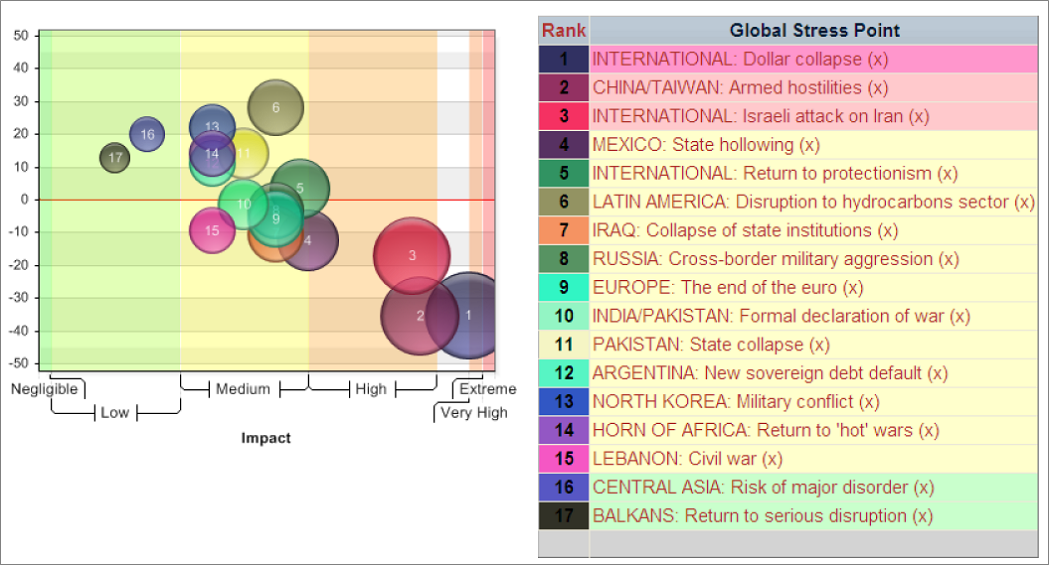
15 Global Stress Points

According to Oxford Analytica, there are 15 "Global Stress Points" ranging from medium to extreme high impact to the entire world. These are listed below ranked by their potential impact.
  1. Dollar Collapse
  2. Taiwan / China Armed Hostility
  3. Israel / Iran Armed Conflict
  4. Mexico State Hollowing
  5. Global Protectionism
  6. Latin America Hydrocarbon Disruption
  7. Iraq State Institutions Collapse
  8. Russia Military Aggression
  9. End of Euro
  10. India / Pakistan War
  11. Pakistan State Collapse
  12. Argentina Sovereign Default 2.0
  13. North Korea Military Conflict
  14. War in North Africa
  15. Lebanon Civil War

(Click to enlarge) Chart Source: Oxford Analytica

It can give us Europeans some comfort that the euro's demise is surprisingly not as big a deal as the Dollar Collapse or a China/Taiwan war.

May 22, 2011

Greece default getting closer

It seems Greece is getting every day closer to bankruptcy.
Fitch Ratings has downgraded again Greece's Long-term foreign and local currency Issuer Default Ratings (IDR) to 'B+' from 'BB+ and the Short-term IDR remains at 'B'. All three ratings have been placed on Rating Watch Negative (RWN).
Norway today realized that supporting a bankrupt country was pointless at this stage and decided to stop providing financial aid which is clearly useless in the current situation.
This is not a major amount of money but certainly it is a clear signal to other countries that time has come to abandon the Titanic.
In the meanwhile Italy which was largely spared by rating agencies has been put in negative watch with possible downgrade. Another clear signal that things are turning very bad in the Eurozone, Italy has largely been ignored by rating agencies despite his stagnant economy and enormous debt due to the size of his economy and its importance in the eurozone, if rating agencies will start targeting Italy in the following months we can expect a major crisis to start immediately after, the big winner in all this mess would be the Dollar which could gain some value back from the demise of the Euro. Let us brace for another Lehman event before US Elections.

April 20, 2011

FED's money printing bonanza

This is a chart of the adjusted US Monetary Base. It’s essentially a very simple means of charting how much money the US Federal Reserve is pumping into the system (on top of QE 2 which is providing another $100 billion in liquidity per month).

As you can see, starting in January 2011, the Fed left a paperweight on the “print” button. Since that time, it’s put $500 billion into the system. When you combine the $100 billion in liquidity provided by QE 2, we’re talking about $800-900 billion entering the financial system in 2011 alone.

There is only one period in which the Fed engaged in a similar amount of money pumps. And that was during the depth of the 2008 Crisis from October- December 2008.


This of course leads one to ask, “what is the Fed combating now?” And it’s not just Japan (the adjusted monetary base went vertical back in January). So what is requiring $200 billion per month?